TRANSMISSION 26.009
The Shape You Gave Me: When Understanding Becomes a Cage
Inside “The Shape You Gave Me” by The Gravity Problem: how observation, categorization, quantum possibility and the human need for certainty became a song about what we lose when naming something becomes defining it.
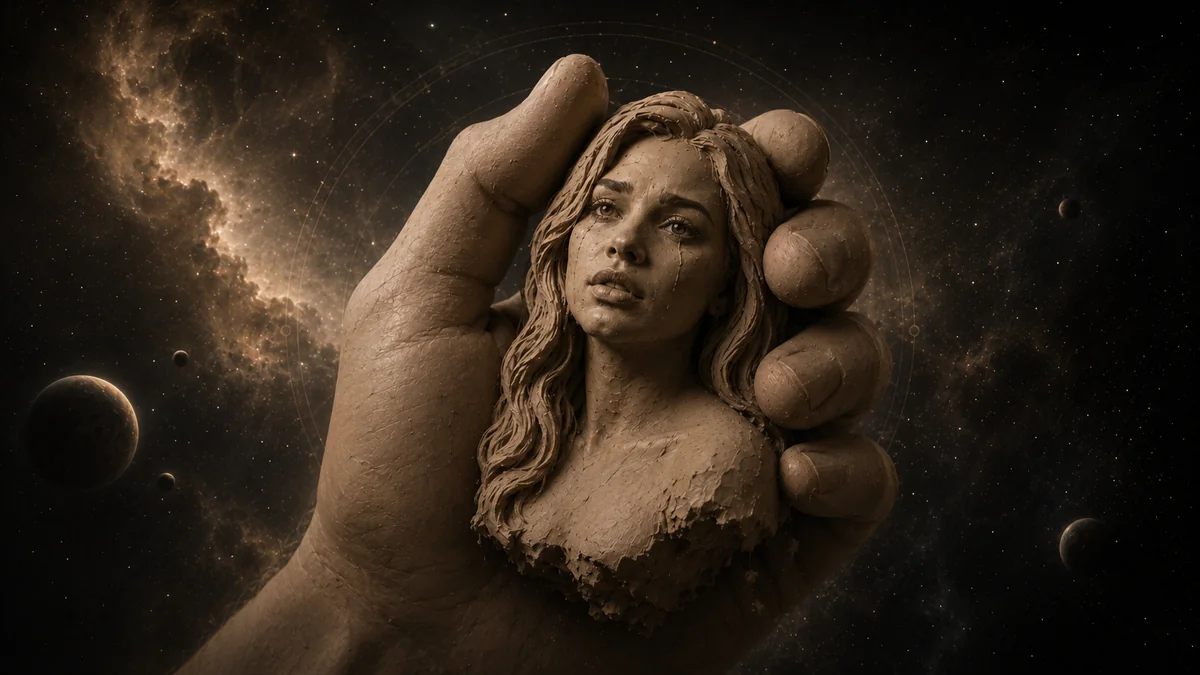
I don’t know who is speaking in “The Shape You Gave Me” by The Gravity Problem.
That’s intentional.
It could be a god complaining about thousands of years of humans deciding what a god is supposed to be.
It could be a person buried beneath labels, expectations, prejudice and identities assigned by everyone except themselves.
It could be an idea that became doctrine.
Or, if you want to read it more satirically, maybe it’s the universe itself—slightly annoyed that humanity keeps insisting on explaining everything instead of occasionally allowing existence to remain incomprehensibly beautiful.
Whoever is speaking, they have the same complaint:
You didn’t discover what I was.
You progressively eliminated everything I was allowed to be.
Before the name
Before your language found my name
I wore ten thousand different flames
I was the tide, the seed, the spark
The morning sun, the endless dark
The song begins before definition.
The narrator isn’t one thing.
They’re contradictory things.
Light and darkness.
Beginning and ending.
Something physical and something abstract.
That’s possible because nobody has drawn the borders yet.
Then language arrives.
Humans need categories. They’re enormously useful.
Without categorization, every object and event would have to be processed as completely unique. Language allows us to recognize patterns, communicate abstractions and compress extraordinary amounts of information into symbols.
Say star, and a single word can invoke an entire class of astronomical objects.
Say tree, and nobody needs a botanical description before understanding roughly what you’re pointing toward.
But compression always leaves something out.
Usually that’s the point.
The Shape You Gave Me asks what happens when we forget that.
Giving the nameless a face
One whispered story, one painted wall
One frightened child began it all
You gave the nameless hands and eyes
And cut the boundless down to size
This is where one possible narrator becomes particularly interesting.
Human cultures have spent thousands of years giving human characteristics to things that aren’t human.
Storms become angry.
Death acquires a face.
Justice holds scales.
The Sun becomes a god.
Forces that are enormous, abstract or incomprehensible acquire personalities, intentions, families, rivalries and bodies.
We call that anthropomorphism: attributing human characteristics to nonhuman entities or phenomena.1
There is something beautiful about it.
And maybe something arrogant too.
A human mind encounters the incomprehensible and says:
Perhaps it looks like us.
Suddenly the boundless fits inside a painting.
Or a statue.
Or a story.
The fragment becomes the whole
One name became another chain
One symbol carved into the stone
You sought to understand the vast
And made the infinite your own
The song isn’t arguing that understanding is bad.
Neither am I.
Understanding requires abstraction.
Science itself depends heavily on models—representations that capture particular properties of a system well enough for us to describe, explain or predict its behavior.
But a model isn’t the thing itself.
Newton’s description of gravity was extraordinarily powerful. General relativity gave us a deeper description. That doesn’t make Newton useless, and it doesn’t require believing that Einstein’s equations printed on a page literally are spacetime.
The representation gives us access to something.
The danger begins when we mistake the representation for the limits of what can exist.
That’s when the model becomes the prison.
The moment the prison closes
Then the chorus arrives:
I am the shape you gave me
Every border fixed in place
You made certainty my prison
Then fixed me in that state
There is something in the performance here that the lyric sheet can’t communicate.
When the vocalist reaches the word “shape” in:
I am the shape you gave me
the delivery changes.
That word is intentionally sung like the instant the confinement becomes real—a strained cry of disbelief.
Shape.
As though the narrator can actually feel the possibilities disappearing around them.
That’s the moment of imprisonment.
And what follows explains why.
You made certainty my prison
Not ignorance.
Certainty.
That’s an important distinction.
The narrator isn’t angry because the observer knows nothing.
They’re angry because the observer believes they now know enough to stop looking.
A fragment can still be true
Then:
You called the fragment by my name
And buried all I could have been
I think fragment may be the most important word in the chorus.
Because the song never requires the observer to be completely wrong.
The fragment might be real.
The mistake is assuming the fragment is the whole.
That’s a much more interesting problem.
People rarely build durable misconceptions entirely from nothing. Often there is some observation underneath them.
Something happened.
Some trait was visible.
Some pattern existed.
Some story was told.
Then the observer extrapolated.
I saw this part of you, therefore this is what you are.
The observation becomes the definition.
When labels begin feeding themselves
Verse two shows what happens next.
You named me fire; I forgot the sea
You named me justice; I forgot to dream
You named me thunder; silence disappeared
You named me vengeance; every echo led me here
Once a label exists, later information can start being interpreted through it.
Psychology gives us a useful concept here: confirmation bias—our tendency to seek, interpret, favor or remember information in ways that reinforce existing beliefs.2
Call someone aggressive and ambiguous behavior can begin looking aggressive.
Call someone brilliant and mistakes become exceptions.
Decide a deity is fundamentally vengeful and generations can preferentially preserve and emphasize the stories that reinforce vengeance.
Eventually the label doesn’t merely describe the evidence.
It helps decide which evidence matters.
Which gives us:
Age after age, the outline held
Each telling stripped another self
You only kept what fit the frame
Until no other shape remained
The story survives.
But possibility doesn’t necessarily survive with it.
Infinite until you saw me
Then the song gets dangerously close to quantum mechanics.
Every witness drew the borders
Every memory fixed the frame
Infinite until you saw me
After that, I stayed the same
This is where it’s tempting to say:
Quantum physics proves observation creates reality.
It doesn’t.
At least, not in the simplistic way that sentence is often used.
Quantum systems can exist in superpositions represented by combinations of possible measurement outcomes. Measurement then yields definite recorded results according to the probabilistic structure of quantum mechanics.3
What that process ultimately tells us about the underlying nature of reality is part of the famous measurement problem, and different interpretations of quantum mechanics offer different answers.
There is no scientific basis for casually concluding that human consciousness simply looks at ordinary objects and forces reality into existence.
That’s not what the song is claiming.
Instead, it borrows the shape of the idea.
Before observation:
possibility.
After observation:
one recorded result.
Then it asks what happens when humans do something psychologically similar.
We encounter something complicated.
We observe one expression of it.
Then we start treating that observation as the boundary of what it can ever be.
The observer doesn’t always leave untouched
The quantum analogy becomes more interesting when we add decoherence.
Quantum systems don’t exist in perfect isolation. They interact with their environments. Through those interactions, quantum coherence between components of a superposition can become effectively dispersed into the environment, suppressing the interference effects that make quantum superpositions experimentally apparent.4
Decoherence helps explain why the macroscopic world around us doesn’t ordinarily behave like an obvious quantum superposition.
But I’m interested in it here as metaphor, not mysticism.
Because observation in human systems isn’t always passive either.
We don’t merely see.
We name.
We publish.
We repeat.
We teach.
We reward.
We punish.
We remember.
We build institutions around interpretations.
Sometimes the observer becomes part of the environment that determines which possibilities remain easy to express.
A face to follow, friend or foe
Then the bridge brings that idea back down to human scale.
You feared the formless and the vast
So you shaped me from the fears you had
You needed something you could know
A face to follow, friend or foe
Uncertainty is uncomfortable.
Categories reduce uncertainty.
That’s one reason stereotypes can be so persistent. They offer cognitively inexpensive frameworks for interpreting complex people and groups.
But people are higher-dimensional than the categories assigned to them.
Someone can be reduced to their appearance.
Their background.
Their job.
Their reputation.
Their politics.
Their mistake.
Their success.
Their diagnosis.
Their age.
Their role in someone else’s life.
Any of those observations might contain information.
None necessarily contains the whole person.
That’s why I don’t want to specify exactly which identity or prejudice the narrator represents.
The cage matters more than the label printed on it.
Almost anyone can recognize some version of it.
You pressed your hunger into clay
Then comes one of my favorite accusations:
You pressed your hunger into clay
Then blamed me for the shape you made
For the deity interpretation, this is almost literal.
Human beings create representations of the transcendent.
We sculpt the statue.
Paint the icon.
Write the mythology.
Assign the motives.
Then generations later, the representation itself can become evidence for what the represented thing supposedly always was.
We made the shape.
Then forgot our fingerprints were on it.
The human interpretation works the same way.
Expectations influence interpretation.
Interpretation reinforces expectations.
Eventually the observer may lose track of how much of the apparent shape belonged to the person—
and how much came from the frame placed around them.
Every answer closed a door
But every answer closed a door
And made me less than I was before
This could sound anti-science if taken out of context.
I mean almost the opposite.
Good science is powerful precisely because its explanations remain answerable to evidence.
Models can be refined.
Hypotheses can fail.
Better measurements can expose inadequacies in older explanations.
Entire frameworks can change when reality refuses to behave as expected.
An answer isn’t the enemy.
The dangerous phrase is:
We have the final answer.
So I enjoy imagining the universe itself as the narrator here.
Humanity spends centuries building increasingly sophisticated descriptions of reality.
Then finally announces:
We’ve figured it out.
And somewhere across the observable universe, spacetime sighs.
Because perhaps the problem was never that we tried to understand the infinite.
The problem begins when we confuse our current understanding with infinity itself.
YOU DIDN’T FIND ME
Then the breakdown stops being philosophical and becomes an accusation.
YOU DIDN’T FIND ME—
YOU FINISHED ME.YOU DIDN’T KNOW ME—
YOU DEFINED ME.
That’s the distinction the entire song has been building toward.
Finding implies discovery.
Defining implies boundaries.
Those aren’t necessarily the same act.
Then:
EVERY NAME—
A SMALLER SKY.EVERY ANSWER—
LET A FUTURE DIE.
Definitions work partly because they exclude possibilities.
That’s useful when we’re defining triangles.
It becomes much more complicated when we’re defining people, cultures, beliefs, identities, unresolved scientific questions—or anything else whose complexity exceeds the category we’ve built for it.
Once something falls outside the definition, it can become invisible to the framework.
Not disproven.
Not impossible.
Just unconsidered.
And unconsidered futures have a difficult time becoming real.
I was more before your eyes
Then the breakdown gives us:
I was more
before your eyes.
This isn’t saying that ignorance is superior to knowledge.
It’s saying that possibility was larger before certainty became rigid.
That’s a very different argument.
The tragedy isn’t that somebody looked.
The tragedy is that after looking once, they stopped permitting the picture to change.
The roads that disappeared
The final verse expands the accusation beyond identity.
I was every road left untaken
Every self denied a name
Every world that lost its future
When one answer fixed the frame
Now the narrator isn’t mourning things that necessarily existed.
They’re mourning things that might have existed.
A person might have developed differently.
A culture might have preserved another story.
An idea might have evolved in another direction.
A scientific assumption might have delayed another question.
A relationship might have become something nobody initially had a category for.
Once one interpretation becomes sufficiently dominant, alternatives don’t have to be formally prohibited.
They can simply become harder to imagine.
And that’s sometimes enough.
The figure you made
Then:
You thought a single voice was speaking
From the figure you had made
I was not the one you trapped within
That resolves the god interpretation beautifully.
The statue speaks.
The doctrine speaks.
The stereotype speaks.
The model speaks.
But the narrator says:
That wasn’t me.
That was the representation.
The figure.
The accumulated expectations.
The shape you gave me.
And after enough generations staring at the figure, perhaps nobody remembers there was ever anything outside its outline.
Everything that might have been
Then there is only one line left:
I was everything that might have been.
That’s where I want to leave the narrator.
Because The Shape You Gave Me isn’t really arguing that we should stop naming things.
We can’t.
We need language.
We need categories.
We need scientific models.
We need abstractions.
Understanding requires them.
The warning is subtler:
Don’t confuse the usefulness of a definition with the completeness of one.
A name can describe something without exhausting it.
A model can explain something without becoming it.
A person can belong to a category without being reducible to it.
A god can survive more than one story.
And the universe can tolerate being understood without surrendering its ability to surprise us.
Maybe that’s the satirical reading I like most.
After billions of years of expansion, stars, galaxies, black holes, quantum fields, planets, life and whatever else we haven’t discovered yet, the universe listens patiently as humanity unveils its latest theory of everything.
We finish the presentation.
We wait.
And the universe says:
That’s adorable.
Because maybe it never objected to being understood.
Maybe it only objected to being finished.
The narrator wasn’t asking to remain unknowable.
Only unfinished.
And those aren’t the same thing.
A name should be a way into understanding.
Not the wall around everything something is allowed to become.
Sources & Further Reading
1. Encyclopaedia Britannica — Anthropomorphism. Background on the attribution of human characteristics to nonhuman entities, natural phenomena, and deities. Read at Britannica ↩
2. Encyclopaedia Britannica — Confirmation Bias. Overview of the tendency to process information in ways that reinforce existing beliefs or expectations. Read at Britannica ↩
3. Stanford Encyclopedia of Philosophy — Quantum Mechanics. Background on superposition, measurement, and the interpretive questions surrounding what quantum measurement means. Read at Stanford Encyclopedia of Philosophy ↩
4. Stanford Encyclopedia of Philosophy — The Role of Decoherence in Quantum Mechanics. Detailed discussion of environmental decoherence and why it should not be confused with simplistic claims that conscious observation creates ordinary reality. Read at Stanford Encyclopedia of Philosophy ↩