TRANSMISSION 26.010
The Gravity Problem: Heavy Is Relative
Inside “The Gravity Problem,” the title track from cinematic space-metalcore project The Gravity Problem: how gravity, relativity, orbital mechanics, collapse and escape became a language for carrying weight without letting it define the trajectory.
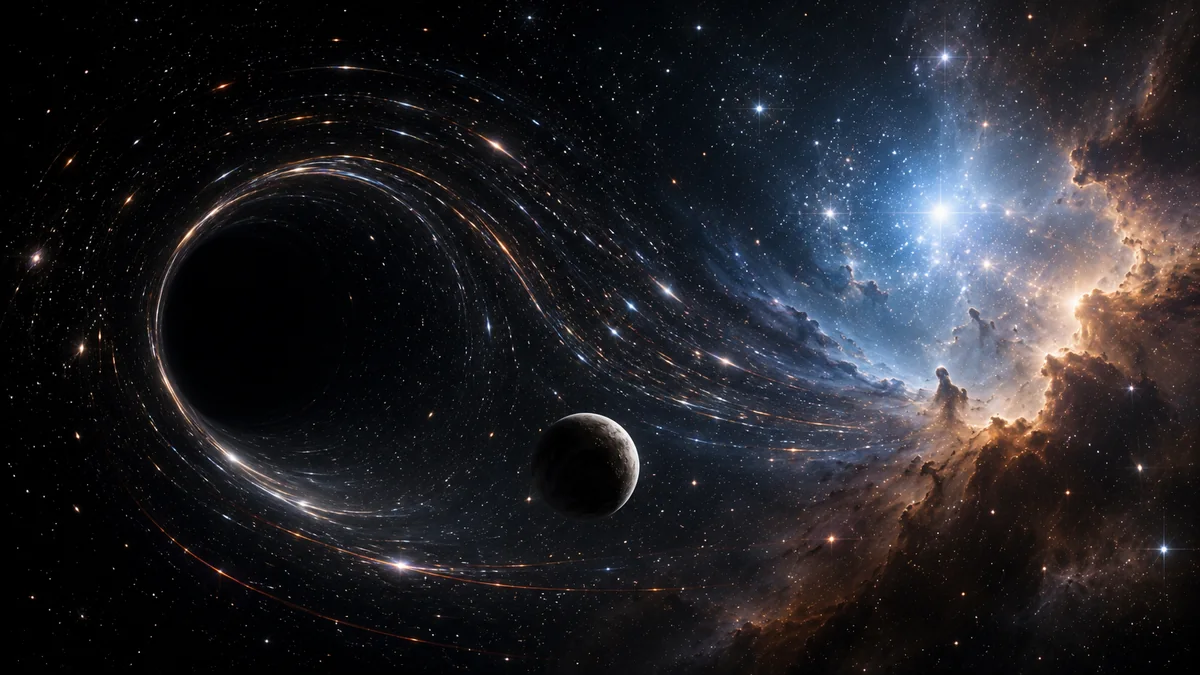
Before there was an album, there was a problem.
Gravity.
Not the equation.
The feeling.
The things we carry. The mistakes that keep orbiting back around. The choices that gain mass the longer we refuse to make them. The forces that pull us toward places we know we shouldn’t stay.
That was the idea underneath “The Gravity Problem” by The Gravity Problem—and eventually underneath the entire project.
Gravity became useful because it could mean almost anything depending on the frame.
It could be love.
Trauma.
Responsibility.
Attraction.
Home.
Fear.
The past.
Sometimes the thing holding you together.
Sometimes the thing you have to escape.
The force remains the same.
The experience of it doesn’t.
Heavy is relative.
Is anyone receiving me?
The song doesn’t begin with an answer. It begins with a transmission.
Starlight spills on the edge of the storm
Static blooms where the darkness is warm
“…¿Alguien me recibe?…”
Is anyone receiving me?
This isn’t someone confidently explaining what they’ve learned after surviving the story. At first, they’re transmitting into uncertainty. There may be someone listening. There may not. There is only static and the decision to transmit anyway.
I learned to breathe in a vacuum of doubt
Humans cannot breathe in a vacuum. That’s precisely why I like the metaphor. The narrator has learned to function inside an environment that should never have been sustainable. That’s not the same as saying the environment became healthy.
Sometimes adaptation is survival. Sometimes it’s evidence that you’ve spent far too long somewhere you shouldn’t have needed to survive.
When mistakes acquire gravity
Counting the cracks in my orbit out loud
Every mistake was a moon pulling near
Tugging the tides of a half-hidden fear
The Moon’s gravitational attraction varies across Earth. The near side experiences a stronger lunar pull than the far side, and those differences contribute to the tidal forces that deform the oceans—and Earth itself.1
That makes tides particularly useful here. The mistakes aren’t simply heavy. They pull unevenly. One part of the narrator gets dragged harder than another. Old choices perturb the present.
Fear that was supposedly hidden begins moving because something has come close enough to disturb it. Regret doesn’t always sit quietly in the past. Sometimes it develops an orbit.
Motion isn’t necessarily escape
Like a comet dragging fire through the black
I was a satellite with no way back
Those are two very different orbital images placed beside one another. The comet looks dramatic. The satellite circles. Again. Again. Again.
Motion does not automatically mean progress.
You can move incredibly fast and remain gravitationally bound to the same system. You can travel enormous distances and still be tracing the same trajectory.
The narrator is moving. But movement alone hasn’t solved anything.
Then something answers
Still in the silence, an echo came to view
A pulse in the void leading me back through
The opening asked: ¿Alguien me recibe?
Now there is a pulse.
I don’t think we need to know exactly what it is. Another person. Hope. Truth. Self-recognition. Some stubborn part of the narrator that kept transmitting even when nobody seemed to answer.
What matters is that there is finally a reference point.
And once you have a reference point, navigation becomes possible.
Mass of the sorrow
Mass of the sorrow, bend but don’t break
Time slows down for the choices we make
In general relativity, mass-energy influences the geometry of spacetime itself, and objects follow paths through that curved geometry.2
One consequence is gravitational time dilation. Clocks deeper in a gravitational field run differently relative to clocks farther from the source. Relativistic time corrections are necessary for systems such as GPS to work accurately.3
The song isn’t claiming emotional sorrow literally curves spacetime. It’s borrowing the experience.
Difficult choices can do something strange to our perception of time. A second can become enormous. A year can disappear. Waiting stretches. Regret loops.
The physics doesn’t prove the psychology.
They simply rhyme.
Escape velocity starts with the truth
We rise through the pressure, we burn through the blue
Escape velocity starts with the truth
Scientifically, escape velocity doesn’t care whether you’re honest. For a spherical body, it depends on its mass and your distance from its center. It represents the speed associated with having sufficient energy to escape that body’s gravitational influence without additional propulsion.4
But emotionally:
escape velocity starts with the truth.
Before you can change trajectory, you have to acknowledge where you actually are. What is pulling? How massive is it? How long have you been orbiting it? What have you mistaken for home simply because you’ve been there long enough?
You can’t navigate away from coordinates you refuse to admit.
Truth doesn’t provide the entire escape.
It provides the first honest measurement.
Help me carry it
Help me carry the gravity problem
Notice what the narrator doesn’t say.
Solve it.
They don’t ask for gravity to disappear.
They ask for help carrying it.
That distinction becomes increasingly important as the song progresses because The Gravity Problem isn’t really structured around defeating some external enemy.
The problem is weight.
And some weight can’t simply be deleted.
Sometimes it has to be understood.
Shared.
Reframed.
Carried differently.
Where relativity loses clarity
Where relativity, loses clarity
This isn’t suggesting Einstein’s theory suddenly stops working.
It’s playing with the word relative.
From outside somebody else’s life, the answer can look obvious.
Leave. Stay. Forgive. Fight. Move on. Hold on.
But the observer outside the gravitational system isn’t experiencing the same forces as the person inside it.
Something that seems trivial from one frame can feel impossibly heavy from another. Something that looks like confinement to one person can feel like home to somebody else.
The physics and human meanings of relative aren’t the same.
But putting them beside one another gives the project one of its central ideas:
Heavy is relative.
Falling into the light
We are the spark in the vastness of space
Falling listless into the light
Usually, falling is framed as descent. Darkness. Failure.
Here, the direction is reversed.
They’re falling toward light.
That matters because gravity isn’t consistently the villain in this song—or anywhere else in the project.
Gravity has no moral alignment.
It gathers. It holds. It pulls. It collapses.
Whether that is salvation or catastrophe depends on the system.
The same gravity that traps one body in an orbit can bring another body home. The same process of gravitational collapse that destroys one configuration of matter can help create a star.
The force doesn’t change sides.
The context changes.
Stars are born from collapse
Hold on, hold on through the collapse
Stars are born from the aftermath
Stars form inside cold clouds of gas and dust when regions become sufficiently dense for gravity to overcome supporting forces and drive collapse. As material contracts, the forming protostar grows denser and hotter. Eventually, under the right conditions, temperatures and pressures in the core become sufficient for sustained hydrogen fusion.5
So collapse isn’t automatically synonymous with failure.
Sometimes collapse is part of the mechanism that creates the conditions for ignition.
That’s an idea that later becomes central to Dust of Dreams.
Here it appears almost as the first law of The Gravity Problem:
pressure can destroy.
Pressure can also create stars.
The difficult part is that while you’re inside the collapse, you don’t necessarily know which one you’re experiencing.
Immutable. Inexcusable.
Pay no mind to the gravity problem
Immutable, inexcusable gravity problem
I love inexcusable here.
Gravity obviously doesn’t owe anyone an apology. It isn’t malicious. It isn’t negligent. It doesn’t care.
That’s what makes blaming it funny.
You can argue with another person. You can explain why something isn’t fair. You can rationalize your own mistakes.
Gravity listens to the entire argument and continues behaving exactly as gravity behaves.
Seriously? Again?
Yes.
Again.
The universe declines to make an exception.
Equations written in scars
Life drew equations in scars on my skin
Force over distance, the war from within
“Force over distance” isn’t being presented as a formal gravitational equation here.
It’s the narrator beginning to read experience as if it contains relationships that can be understood.
Force. Distance. Mass. Trajectory. Consequence.
The scars become data.
Not because reducing pain to an equation makes it disappear, but because something changes when an experience can finally be examined instead of merely endured.
I carried failure like iron and stone
A singular weight I mistook for my home
That’s one of the lines that most clearly expresses what the gravity problem actually is.
Carry something long enough and eventually you can stop recognizing it as cargo.
It becomes environment.
Then routine.
Then identity.
Then home.
The weight didn’t necessarily belong there.
You simply forgot what it felt like not to carry it.
Even black holes give something back
But even black holes can surrender their glow
Classically, the event horizon of a black hole marks a boundary beyond which signals cannot escape to the outside universe.
But quantum field theory in curved spacetime produces one of the strangest predictions in modern physics: Hawking radiation.
Black holes can emit thermal radiation through quantum effects associated with the horizon. In doing so, they lose energy and therefore mass. Given enough time—and absent sufficient incoming material—they can theoretically evaporate.6
That’s not literally a black hole deciding to release trapped light.
But the metaphor is too good not to use.
Even the object culturally defined by nothing escapes may not keep everything forever.
Even black holes change.
Even black holes lose mass.
Even black holes have an ending.
Lost planets remember the road
Even lost planets remember the road
Planets don’t remember anything.
But trajectories carry history.
At any given moment, an object’s position and velocity contain information that determines how it will continue evolving under the forces acting on it.
So “remember” here isn’t memory in the biological sense.
It’s continuity.
The past isn’t gone merely because the object has moved.
Its current trajectory contains the consequence of everything that happened before.
Change the vector
So I align, taking time to reframe
Changing my vector, refusing the same
A vector contains both magnitude and direction.
That means changing the future doesn’t always require erasing all of the energy already in the system.
Sometimes the crucial change is directional.
Where is all of this motion actually taking me?
You don’t necessarily need to deny the past. You don’t need to pretend the force never existed. You may need to change the direction in which the accumulated energy is carrying you.
That’s where this title track quietly anticipates Frame Shift.
Same history.
Different frame.
Different vector.
Different future.
The harder the impact
The harder the impact, the brighter we fuse
No law of motion can silence the truth
This is poetic physics, not a universal law.
Harder impacts do not automatically create something better. And fusion isn’t simply what happens whenever matter collides violently.
Nuclear fusion requires extreme physical conditions in which atomic nuclei can overcome their mutual electrostatic repulsion closely enough for the strong nuclear interaction to bind them. Stars achieve those conditions through enormous temperature, density and pressure.7
The lyric compresses all of that into an emotional proposition:
what hits us can sometimes become part of what powers us.
Not inevitably.
Not pain as some magical requirement for growth.
But the possibility that energy arriving destructively can be transformed into something that doesn’t remain destruction.
Respira
Respira…
Ay… Dios mío…
Breathe.
After gravity. Relativity. Tides. Escape velocity. Collapse. Black holes. Vectors.
The immediate instruction is:
Breathe.
I like the scale change.
We’ve spent the whole song measuring forces large enough to shape stars and spacetime.
And survival, right now, is one breath.
Tear the fear from the core
I won’t sink anymore
Crush the doubt, split the night
I am more than my fight
The narrator is no longer merely describing the gravity problem.
They’re acting inside it.
A collapsing singularity
In the pressure, I become
Brighter than the dying sun
A collapsing singularity
Changing every part of me
A singularity in general relativity isn’t an ordinary object we understand as simply compressing and transforming in the familiar sense.
In classical general relativity, singularities indicate regions where the theory predicts quantities such as spacetime curvature becoming pathological or unbounded. Most physicists expect that a complete theory of quantum gravity would be needed to understand what actually occurs under those extreme conditions.8
And that’s exactly why I like it here.
The narrator reaches a regime where the old description fails.
The equations that worked before no longer give us a comfortable picture of what happens next.
That’s an excellent place to put transformation.
Changing every part of me.
Not because a singularity is a scientifically established mechanism for personal rebirth.
Because sometimes transformation reaches a point where the vocabulary that described the person before isn’t sufficient anymore.
Three choruses, one trajectory
The most important structural detail in the song may be easy to miss because most of the chorus remains the same.
But the first line changes.
The first time:
Help me carry the gravity problem
The second:
Time slips by in the gravity problem
And finally:
Learning to live with the gravity problem
That’s the character arc.
Help me.
Then:
I’m inside it.
Finally:
I can live with it.
Gravity never disappears.
There is no triumphant moment where the narrator destroys the fundamental force and floats away untouched.
The problem remains.
What changes is the relationship to it.
And that is probably the clearest statement of what this entire project means to me.
Weightless doesn’t mean gravity is gone
Now the dawn bends around our scars
We are dust, we are flame, we are stars
In the quiet after the roar
We are weightless forevermore
There’s one last piece of physics hiding in the ending.
Weightlessness does not necessarily mean an absence of gravity.
Astronauts aboard the International Space Station experience apparent weightlessness even though Earth’s gravity is still acting strongly on them.
They are in continuous free fall.
The station and everything inside it are falling together around Earth.9
And I almost prefer that interpretation for the song.
Maybe the narrator never escaped gravity at all.
Maybe they learned to fall with it differently.
The force remains.
The experience of the force changes.
Which brings us back to where the entire project started.
Heavy is relative
The Gravity Problem isn’t a problem because gravity is broken.
Gravity works perfectly.
That’s what makes it such a problem.
It keeps pulling.
It bends trajectories.
It gathers matter.
It destroys structures.
It builds stars.
It holds planets in orbit.
It makes departure difficult.
It brings comets home.
Across the rest of the album, gravity becomes love, resentment, creation, confinement, attraction, memory and return.
In Mass Driver, it’s something to escape.
In Roche Limit, it’s powerful enough to destroy two old structures and gather their pieces into something new.
In Sheila’s Comet, it’s the connection that makes an enormous departure part of the path home.
In Dust of Dreams, it gathers scattered matter until a star can exist.
In Frame Shift, the force may stay the same while another perspective changes what the situation means.
But The Gravity Problem establishes the rule that allows all of those metaphors to coexist:
the force stays the same.
What changes is the frame.
Some gravity problems need escape velocity.
Some need another orbit.
Some need another person to help carry the mass.
And some never disappear at all.
You simply stop mistaking the weight for the whole of who you are.
By the final chorus, the narrator hasn’t solved gravity.
They’ve learned to live with it.
And that may be the most important answer The Gravity Problem ever gives.
Heavy is relative.
Sources & Further Reading
1. NOAA — Tides and Water Levels. Background on how the Moon’s and Sun’s gravity contribute to Earth’s tides. Read at NOAA ↩
2. NASA — General Relativity and Gravity. Background on Einstein’s description of gravity as the curvature of spacetime produced by mass-energy. Explore NASA ↩
3. NIST — Relativity and GPS. Atomic clocks and satellite navigation require relativistic corrections, including effects associated with gravity and motion. Read at NIST ↩
4. NASA Glenn Research Center — Escape Velocity. Escape velocity describes the speed required to escape a body’s gravitational influence without further propulsion. Read at NASA ↩
5. NASA Science — Stars. Stars form when gravity collapses dense regions of gas and dust until protostars become hot and dense enough for sustained fusion. Read at NASA Science ↩
6. NASA Science — Black Holes. Background on event horizons and black-hole physics, including the theoretical loss of mass through Hawking radiation over immense timescales. Read at NASA Science ↩
7. NASA Science — Stellar Fusion. Stellar cores reach the extreme temperatures and pressures needed for nuclear fusion. Read at NASA Science ↩
8. NASA Science — Black Holes and Singularities. General relativity predicts singular behavior in idealized black-hole interiors, while a complete quantum-gravity description remains unresolved. Read at NASA Science ↩
9. NASA — Microgravity. Astronauts in orbit experience apparent weightlessness because spacecraft and occupants are in continuous free fall around Earth. Read at NASA ↩