TRANSMISSION 26.002
Slow Red Death: Mars Has a Grudge
Inside “Slow Red Death” by The Gravity Problem: the real Mars science behind a metal song about atmospheric loss, vanished oceans, planetary evolution, and four billion years of resentment toward Earth.
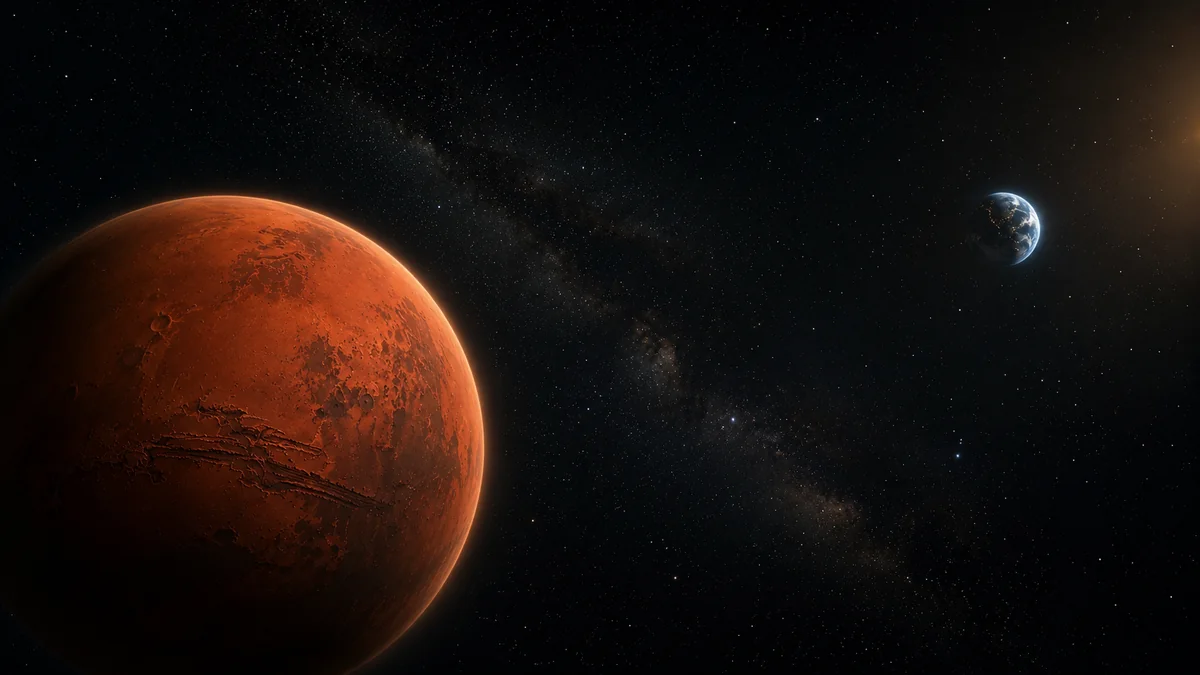
There are a lot of ways to write a song about Mars.
You can write about astronauts. Exploration. Aliens. The loneliness of standing on another world.
“Slow Red Death” by The Gravity Problem starts somewhere else entirely.
In Slow Red Death, The Gravity Problem turns the planetary history of Mars into something much more personal: a four-billion-year grievance against Earth.
Mars is the narrator.
And Mars is pissed.
Not screaming-at-the-universe angry, exactly. This is older than that. This is the resentment of something that has spent billions of years watching the planet next door become everything it might have been.
Earth has oceans.
Earth has weather.
Earth has a thick atmosphere, a restless crust, and a magnetic field generated deep inside it.
Earth has life.
Mars has rust.
And from Mars’s point of view, that’s particularly hard to accept because they came from the same place.
Twin born from the same collapsing cloud
You drank the mass, I starved in the crowd
Sibling worlds. Unequal portions.
Go back roughly 4.6 billion years and there is no Earth or Mars.
There is a rotating cloud of gas and dust collapsing under gravity. The Sun forms at its center. Around it, material in the protoplanetary disk begins colliding, sticking together and assembling the rocky worlds of the inner Solar System.
Earth grew.
Mars did too—but then, comparatively speaking, Mars stopped.
Today Mars has only about 11% of Earth’s mass. Why it remained so small is still an active question in planetary science. One influential family of models—the Grand Tack scenario—suggests that the early migration of Jupiter and Saturn redistributed material in the young inner Solar System, leaving far less available where Mars ultimately formed.1
Which makes the lyric wonderfully unfair:
Same dust, same fire, same violent birth
You swelled to twice my girth, you called it worth
Mars doesn’t care about orbital-dynamics models.
Mars just knows Earth got more.
And being smaller would have consequences.
A smaller world grows old differently
Planets contain heat left over from their formation and from radioactive decay. Over geological time, they lose that heat.
Size matters. Smaller planets generally lose their original internal heat more quickly than larger ones, and NASA’s InSight mission was designed in part to understand how that different thermal history shaped Mars.2
Earth remains extraordinarily geologically active. Its lithosphere is divided into plates that are continuously created, moved, recycled and destroyed.
Mars followed another path.
It has had spectacular volcanism—Olympus Mons is ample evidence of that—but it does not operate with Earth’s present global system of mobile tectonic plates. Its crust behaves much more like one enormous shell, preserving ancient structures that Earth’s geological conveyor belt has long since recycled.3
That distinction gives Mars another accusation:
You kept your churning skin, your moving plates
I barely even moved out of the starting gates
The lyric compresses complicated planetary evolution into two lines, but that’s the point.
Earth kept moving.
Mars gradually became still.
Then its shield failed
Early Mars appears to have generated a global magnetic field from a dynamo within its interior.
Today it doesn’t.
Mars still has intensely magnetized regions preserved in its ancient crust—geological remnants of an earlier era when a planetary dynamo was operating—but it no longer possesses an internally generated global magnetic field like Earth’s.4
Which turns:
My core went cold before the story started
No shield, no pulse, I bled out iron-hearted
into more than imagery.
The scientific details of exactly when and why the Martian dynamo shut down are more complicated than a single lyric can—or should—capture. The line is Mars telling its own simplified version of the autopsy.
And once the song’s Mars loses its shield, the chorus arrives.
Tear the atmosphere right off my face
This might be my favorite collision between the science and the metal in the entire song.
The Sun continuously throws a stream of charged particles into space: the solar wind.
NASA’s MAVEN mission has shown that solar wind and radiation were major drivers of atmospheric loss from Mars, helping transform a world that once had a much thicker atmosphere into the cold, dry planet we see today.5
In 2025, MAVEN directly observed atmospheric sputtering at Mars—a long-predicted process in which energetic particles transfer enough energy to atmospheric atoms and molecules to knock some of them away into space.6
The scientific term is atmospheric escape.
Mars has another name for it.
Tear the atmosphere right off my face
The sun’s own breath leaving not a trace
That’s metal enough without embellishment.
The rivers are still there
The tragedy is that Mars wasn’t always the desert we see today.
Its surface preserves abundant evidence that liquid water once moved across it: ancient streambeds, channels, lake environments, water-altered minerals and sedimentary structures. Curiosity has even examined conglomerate rock containing rounded gravel that could only have been transported by vigorous flowing water.7
So when Mars sings:
My oceans ran and cut these dry canyons wide
Rivers of grief with nowhere left to hide
the landscape itself becomes part of the narrator.
Mars doesn’t need photographs of its younger self.
The scars are still carved into its surface.
As the atmosphere thinned and conditions changed, stable liquid water became increasingly difficult to maintain at the surface. Some water remains locked in ice and minerals. Some was ultimately lost to space along with the atmosphere.
Earth kept its blue.
Mars remembers having its own.
You got the firmament, the crawling first breath
I got the rust, the silence, and the slow red death
And there is the grievance in six lines.
Earth didn’t merely survive.
Something started crawling on it.
And then Earth’s children showed up
This is where the song gets mean.
Because billions of years later, the one planet Mars has been watching sends machines to come look at the corpse.
Spirit.
Opportunity.
Curiosity.
Perseverance.
Those names are irresistible when the planet itself is narrating.
My Spirit lies down, inspiration gone dark
Opportunity, a cold forgotten spark
The rover names stop being mission names and become things Mars has literally lost.
Then:
Curiosity a thing of the past
Perseverance dead, I’m so aghast
Now Mars is using humanity’s own optimistic language against it.
Even worse, those machines exist because Earth produced creatures capable of building them.
Your children left their footprints in the sand
I never held a single living hand
The “children” are Earth’s explorers—robotic for now—but from Mars’s perspective the distinction hardly matters.
Earth made something alive enough and clever enough to reach across interplanetary space.
Mars never got to make anything that could reach back.
So Mars throws a tantrum
Eventually resentment needs somewhere to go.
By the bridge, Mars starts throwing pieces of itself—and pieces of Martian history and mythology—back at us.
I’ll throw my tantrum in the iron above
The tantrum is literal Martian weather. Mars’s red color comes largely from iron oxides in its dust, and its winds can lift that material high into the atmosphere. Martian dust storms can grow to extraordinary scales, sometimes expanding until they obscure much of the planet.8
Mars doesn’t need thunderclouds to rage.
It can throw its own rust into the sky.
Then the song reaches into one of the strangest chapters of Mars’s cultural history:
A face carved out of everything that I’m made of
In 1976, Viking 1 photographed a landform in the Cydonia region that, under the particular lighting and resolution of the image, appeared remarkably like a human face. Later, much higher-resolution observations showed the feature to be an ordinary mesa—but by then the “Face on Mars” had already become one of the most famous images associated with the planet.9
The song lets Mars claim the illusion as its own self-portrait.
Then the perspective suddenly crosses the distance between the planets:
Look up and see me hanging there
Because we can.
Mars is visible from Earth with the unaided eye, appearing as a distinctive reddish point of light in our night sky.10
The planet that has spent the entire song watching Earth can simply remind us to look up.
And the final line hides one more Martian reference:
Terror in a sky I never learned to share
Mars has two small moons: Phobos and Deimos. Their names come from Greek mythology, where they accompany Ares—the Greek counterpart of Mars. Phobos is associated with fear and panic. Deimos is associated with terror and dread.11
So “terror” isn’t merely describing the Martian sky.
Terror is literally orbiting Mars.
The bridge isn’t Mars abandoning the science to become theatrical.
It’s Mars turning its own weather, geography, visibility and moons into the tantrum.
The slow red death
What makes the point of view so much fun is that none of this requires Mars to understand the science incorrectly.
We understand planetary evolution as physics.
Mars experiences it as biography.
We say mass distribution.
Mars says:
You drank the mass.
We say dynamo cessation.
Mars says:
No shield. No pulse.
We say solar-wind-driven atmospheric escape.
Mars says:
You tore the atmosphere off my face.
We see dry channels as evidence of ancient hydrology.
Mars remembers the rivers.
And Earth hangs there in the Martian sky as proof that things could have gone differently.
That’s what makes Slow Red Death such an awesome metal song to me. The science doesn’t sit behind the lyrics as trivia.
The science is the reason the narrator is angry.
Every discovery we make about ancient Mars gives it another memory.
Every comparison with Earth gives it another grievance.
And after all the screaming, rust, dead rovers, vanished oceans and four billion years of resentment, Mars gets the final word:
I was your equal in the dark
I am the ashes of what you are
Mars isn’t imagining some alien apocalypse.
It is looking at Earth and seeing the life it believes it should have had.
And looking at itself as what Earth could still become.
That is the Slow Red Death.
Sources & Further Reading
1. NASA Astrobiology — “Mars and Earth May Not Have Been Early Neighbors.” Discussion of Mars’s small mass and Grand Tack formation models. Read at NASA ↩
2. NASA Jet Propulsion Laboratory — “NASA’s InSight Has a Thermometer for Mars.” On planetary size, heat loss and Mars’s thermal evolution. Read at NASA/JPL ↩
3. NASA Jet Propulsion Laboratory — “What Two Planetary Siblings Can Teach Us About Life.” Earth/Mars comparison and the absence of Earth-like plate tectonics on Mars. Read at NASA/JPL ↩
4. NASA — “Earth and Martian Magnetic Fields.” Comparison of Earth’s active global dynamo with the fossil magnetic remnants preserved in Mars’s crust. Read at NASA ↩
5. NASA — “NASA’s MAVEN Reveals Most of Mars’ Atmosphere Was Lost to Space.” MAVEN measurements linking solar wind and radiation to long-term atmospheric loss. Read at NASA ↩
6. NASA Science — “NASA’s MAVEN Makes First Observation of Atmospheric Sputtering at Mars.” Direct observation of a long-predicted atmospheric escape mechanism. Read at NASA Science ↩
7. NASA Science — “Remnants of Ancient Streambed on Mars.” Curiosity evidence for vigorous ancient flowing water on the Martian surface. Read at NASA Science ↩
8. NASA Science — “The Fact and Fiction of Martian Dust Storms.” How Martian dust storms form, grow and can sometimes become planet-encircling events. Read at NASA Science ↩
9. NASA Science — “Unmasking the Face on Mars.” The Viking-era Cydonia image and later higher-resolution observations showing the famous “face” as a natural landform. Read at NASA Science ↩
10. NASA Science — Mars Facts. Mars can be observed from Earth with the unaided eye and is recognizable by its reddish appearance. Read at NASA Science ↩
11. NASA Science — Mars Moons: Phobos & Deimos. Background on Mars’s two moons and the mythological origins of their names. Read at NASA Science ↩