TRANSMISSION 26.008
Sheila’s Comet: The Gravity That Brings Us Home
Inside “Sheila’s Comet” by The Gravity Problem: how cometary orbits, aphelion, the Oort Cloud and the Sun’s distant gravitational pull became a love song for my wife—and a year spent apart with the return already written into the trajectory.
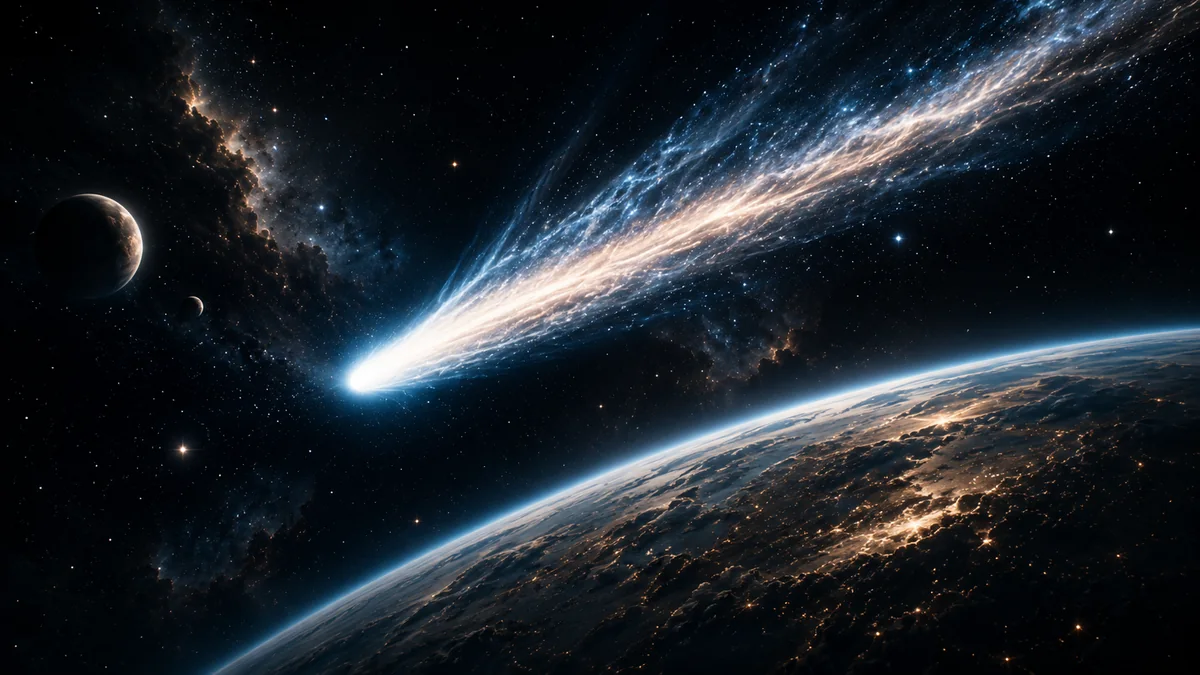
Some metaphors begin with the science.
This one began with my wife.
“Sheila’s Comet” by The Gravity Problem is named for Sheila, my wife, who is leaving for work and will be away for roughly a year.
I know the separation is temporary.
I know why it has to happen.
I know there is an end to it.
None of that makes a year feel short.
So I started thinking about something that can travel unimaginably far from the thing holding it, spend an enormous stretch of time moving through darkness, reach the most distant point in its journey—
and still be on its way home.
A comet.
Occasionally, we must depart
A solo journey away from our heart
That became the premise of Sheila’s Comet.
The distance is real.
The separation is real.
But so is the orbit.
And the return is already written into the trajectory.
Leaving isn’t the same as leaving us
There’s an important distinction at the beginning of this song.
Nobody is leaving the relationship.
One person has to leave geographically because sometimes life asks that of us.
A gravitationally bound comet gives me a way to think about that.
When a comet is traveling outward from the Sun, it can spend years—or vastly longer—moving farther and farther away.
But outward motion doesn’t necessarily mean escape.
If the comet remains gravitationally bound to the Sun, traveling away is simply one part of the orbit.
That’s the idea I wanted.
Departure and return aren’t opposites.
They’re different portions of the same path.
Leaving pieces behind
Then the comet starts behaving like a comet.
Through solar wind I scatter debris
Every mile behind trails a piece of me
A comet nucleus is essentially an ancient collection of ice, dust, rock and frozen volatile compounds left over from the formation of the Solar System.
When a comet approaches the Sun, solar heating causes some of its frozen material to sublimate—changing directly from solid into gas. Escaping gas carries dust away from the nucleus and creates the diffuse coma surrounding it.
Radiation pressure and the solar wind then help shape the comet’s tails, which generally extend away from the Sun.1
From Earth, that process can make a comet spectacular.
But I liked turning the perspective around.
What looks beautiful to us is material being lost by the comet.
Which becomes:
Every mile behind trails a piece of me
The journey leaves evidence.
And then the chorus makes that explicit:
I am the comet, burning for what I leave
Distance makes me shine in my grief
That’s one of the central ideas of the song.
Sometimes the thing that looks strong or beautiful from the outside is being produced by the cost of the journey itself.
The comet shines.
But it shines because something is being left behind.
A mission that borrows my time
I’m on a mission that borrows my time
Can’t help but miss you in the mean-time
I chose borrows deliberately.
Not takes.
Borrows.
Because borrowed things are supposed to be returned.
The work gets the time.
The distance gets the year.
Neither gets forever.
And once I started thinking about the separation as an orbit rather than a straight line, there was an astronomical term waiting for exactly the point I needed.
Aphelion
I’ll reach aphelion, farthest I will ever run
Only so far I can be from my sun
Aphelion is the point in an object’s orbit around the Sun where it reaches its greatest distance from the Sun.2
For the metaphor, that’s maximum separation.
Somewhere inside a year apart is a point where you’ve gone as far into the separation as you’re ever going to go.
And I find something strangely comforting about that.
Because aphelion isn’t simply the farthest point.
It’s also the turning point.
The distance has reached its maximum.
There is no farther away left to go.
After aphelion, the geometry of the journey changes.
You’re coming back.
The Sun doesn’t have to chase the comet
Then the chorus establishes the relationship:
I am the comet, burning for what I leave
Distance makes me shine in my grief
Locked in resonance, I hold fast to your pull
You’re the sun I fall toward, making my heart full
The Sun doesn’t chase the comet.
It doesn’t need to.
Gravity remains.
And that’s what makes gravity mean something very different in this song than it does elsewhere in The Gravity Problem.
In Mass Driver, gravity was the force that had to be escaped.
In Roche Limit, getting too close allowed gravity’s tidal effects to tear old structures apart.
In Dust of Dreams, gravity gathered scattered material until something new could ignite.
Here:
gravity is home.
The pull isn’t confinement.
It isn’t destruction.
It’s connection.
A note about resonance
There’s a little poetic compression hiding inside:
Locked in resonance, I hold fast to your pull
Orbital resonance has a more specific scientific meaning than the song gives it.
A resonance occurs when orbiting bodies have periods related by ratios of small integers, causing their gravitational configurations and interactions to repeat regularly. Orbital resonances are important throughout the Solar System, and Jupiter in particular has profoundly influenced populations of asteroids and comets through resonant gravitational interactions.3
But a comet doesn’t need to be in orbital resonance with the Sun to return to it.
A bound orbit is enough.
So “resonance” here is intentionally doing more poetic work than orbital-mechanics work.
It’s the idea of two things remaining tuned to one another despite the distance.
The science underneath the actual return is simpler:
the comet never stopped belonging to the orbit.
Into the Oort Cloud
Then the scale becomes almost absurd.
Oort Cloud silence, out so far
Still I hold your light like a jar of what we are
The Oort Cloud is a hypothesized enormous population of icy bodies surrounding the Solar System at extreme distances.
NASA estimates that its inner edge may begin somewhere around 2,000 to 5,000 astronomical units from the Sun, with the outer region potentially extending tens of thousands of AU or farther.4
One astronomical unit is the average distance between Earth and the Sun.
So when we talk about the Oort Cloud, we’re not talking about something slightly beyond Neptune.
We’re talking about a structure so distant that its scale begins to make the familiar Solar System feel tiny.
We haven’t directly photographed the Oort Cloud as a giant shell surrounding us.
Its existence is inferred largely from the trajectories of long-period comets arriving from extraordinarily distant regions.
That uncertainty actually makes it better for the song.
The comet has traveled so far that home has become something almost abstract.
And yet:
Still I hold your light like a jar of what we are
At that distance, the Sun wouldn’t dominate the sky the way it does from Earth.
But the lyric isn’t really talking about illumination anymore.
It’s talking about carrying something with you when the source of it is far away.
Memory.
Warmth.
The knowledge of where home is.
Crossing the edge of home
Then:
Heliosphere behind me, edge of home, of you
Carrying your warmth, no wind can chill through
The heliosphere is the enormous bubble created by the solar wind as it pushes outward into the surrounding interstellar medium.
Its outer boundary is the heliopause, where the solar wind’s outward influence yields to the interstellar environment.
Voyager 1 crossed the heliopause in 2012.
Voyager 2 followed in 2018.5
Both spacecraft entered interstellar space.
That’s an extraordinary phrase:
interstellar space.
It sounds like the Solar System should be over.
But gravitationally, things aren’t that simple.
The Sun’s gravity doesn’t switch off at the heliopause.
The heliosphere is a boundary of the solar wind and magnetic environment—not a wall where the Sun suddenly loses all influence.
Which gives the lyric exactly what I wanted from it.
You can cross a recognizable boundary of home.
You can enter an environment that is fundamentally different from the one you left.
And still remain connected to where you came from.
Gravity gets weaker
That doesn’t mean distance is meaningless.
Gravity weakens rapidly with separation.
For two masses, gravitational force decreases with the square of the distance between them.6
Move twice as far away and the gravitational force becomes one quarter as strong.
Ten times farther and it becomes one hundredth as strong.
But weaker isn’t the same thing as gone.
A body on a sufficiently large bound orbit can travel to extraordinary distances while remaining gravitationally connected to the same system.
That’s probably the scientific idea closest to the emotional center of Sheila’s Comet.
Connection doesn’t always feel equally strong at every distance.
Presence changes.
Routine changes.
Communication changes.
The physical reality of sharing a life changes for a while.
But distance doesn’t automatically erase the relationship.
The path bends home
Then:
No matter the breadth, no matter the scale
My path bends back to you, like a roaring gale
A bound comet doesn’t travel outward forever.
Its path curves under gravity.
As it approaches aphelion, its outward motion slows.
At the farthest point, the comet begins the inward portion of its orbit.
The same gravity that allowed it to travel so far without escaping is the gravity that brings it back.
That’s why I like bends.
The comet doesn’t suddenly make a U-turn.
The trajectory was curved all along.
From close enough, a small section of the path might have looked like departure.
From far enough away, you can see the whole orbit.
And the whole orbit includes home.
Sometimes there isn’t a villain
Eventually the astronomy steps aside.
It felt empty without you in the expanse
Unfortunate victims of circumstance
There’s no antagonist in this song.
Nobody betrayed anyone.
Nobody needed to escape.
Nobody collided and blew their old lives apart.
Life simply put distance between two people who would rather not have it there.
And sometimes that’s harder to write about because there isn’t anything to fight.
You can’t scream at orbital mechanics.
You can’t defeat the calendar.
You just live through the distance.
That’s what the bridge admits.
It feels empty.
That’s allowed.
Knowing the separation has an end doesn’t make the middle painless.
I was never gone
Then:
But nothing in these cosmos can keep me long
Blaze the trail back burning, I was never gone
“I was never gone” sounds contradictory after a song built around enormous separation.
But gone can mean two different things.
You can be geographically absent.
Or you can be absent from the relationship.
The comet traveled.
The distance grew.
The environment changed.
But the orbit never disappeared.
So in the sense that matters:
it was never gone.
Not every comet comes back
The final chorus gives us the promise:
I am the comet, burning fast back to you
While I was away, it was you who pulled me through
Cross the whole cold dark to fall into your hands
Comets always come back as gravity demands
Scientifically, I owe that last line an asterisk.
Not every comet comes back.
Some comets are destroyed.
Some collide with planets or the Sun.
Some can have their trajectories altered enough by gravitational encounters to be ejected from the Solar System entirely.
And some long-period comets take thousands—or potentially far longer—to complete a single orbit.7
But a bound periodic comet comes back.
And Sheila’s Comet was always meant to be one of those.
Because this isn’t a song about wondering whether the comet will return.
It’s about enduring the distance before it does.
The return isn’t the uncertainty.
The waiting is.
Siempre volveré a ti
Then all of the astrophysics disappears.
Siempre volveré a ti.
I will always return to you.
That’s it.
That’s what aphelion was trying to say.
That’s what the orbit was trying to say.
That’s what the Oort Cloud, heliosphere, solar wind and gravity were all trying to say.
A year can be long.
Home can feel impossibly distant.
There will be days when the separation feels larger than it really is because you’re experiencing only one small section of the trajectory.
But distance is only one coordinate of the journey.
Direction matters too.
And eventually there comes a point where you’re no longer getting farther away.
You’ve reached aphelion.
The path has turned.
You’re coming home.
That’s why I wrote Sheila’s Comet.
Not because separation doesn’t matter.
Because it does.
Not because distance doesn’t hurt.
Because it can.
I wrote it because sometimes you need to remember that leaving and losing are not the same thing.
Some journeys are departures.
Others are orbits.
And if you know which one you’re on, the farthest point carries a promise inside it:
from here, every mile eventually leads back home.
Sources & Further Reading
1. NASA Science — Comets. Overview of comet nuclei, sublimation, comae, and how solar radiation and the solar wind shape comet tails. Read at NASA Science ↩
2. NASA — Orbital terminology and aphelion. Aphelion is the point in a heliocentric orbit at greatest distance from the Sun. Explore NASA orbital mechanics ↩
3. NASA Science — Orbital Resonances. Repeating gravitational relationships among orbiting bodies can shape the architecture and small-body populations of planetary systems. Explore NASA Solar System science ↩
4. NASA Science — Oort Cloud. The distant hypothesized reservoir of icy bodies surrounding the Solar System and source region for many long-period comets. Read at NASA Science ↩
5. NASA Science — Voyager Interstellar Mission. Voyager 1 and Voyager 2 crossed the heliopause and entered interstellar space while remaining gravitationally influenced by the Sun. Read at NASA Science ↩
6. NASA Glenn Research Center — Newton’s Law of Universal Gravitation. Gravitational force decreases according to the inverse square of the distance between masses. Read at NASA ↩
7. NASA Science — Comets. Comets can follow short- or long-period orbits, be dynamically altered, break apart, collide with other bodies, or in some cases leave the Solar System. Read at NASA Science ↩