TRANSMISSION 26.007
Roche Limit: When Gravity Makes Separate Lives Impossible
Inside “Roche Limit” by The Gravity Problem: how tidal forces, orbital disruption and gravitational reassembly became a song about two people choosing the collision that destroys their old lives—and builds a new one together.
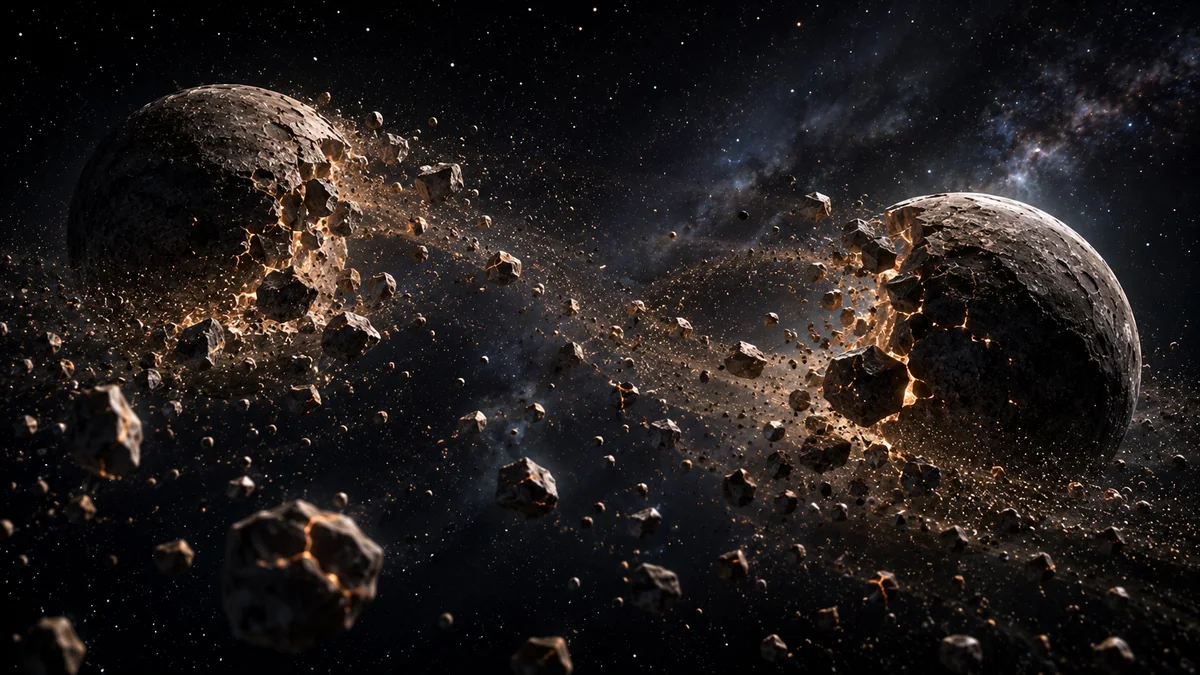
Not every stable orbit is a good one.
Sometimes stability just means you’ve been doing the same thing long enough that you’ve stopped expecting anything else.
That’s where “Roche Limit” by The Gravity Problem begins.
Not with two people searching for each other.
Not with destiny.
Not even with hope.
Just two bodies that have apparently become accustomed to going around in circles.
I trace the same dead circle, worn into the dark
A path I never picked, but I stopped fighting the arc
Gray rock, no fire, just a body killing time
Wobbling through the silence like it’s fine, like it’s fine
The orbit works.
That’s the problem.
Nothing is forcing the narrator out of it.
Then something passes close enough for gravity to matter.
The orbit you stopped questioning
An orbit is continuous motion under gravity.
A body has velocity carrying it forward while gravity continuously changes the direction of that motion. Under the right conditions, the result can be an orbit that persists for an extraordinarily long time.1
There is nothing inherently unhappy about orbital stability.
But that’s what makes it useful as a metaphor.
A stable system doesn’t have to ask whether anyone inside it is fulfilled.
It only has to keep functioning.
The narrator has reached that kind of equilibrium.
A path I never picked, but I stopped fighting the arc
That’s more interesting to me than simply being trapped.
At some point she stopped trying to leave.
The trajectory became routine.
Then another trajectory enters the system.
I felt the pull before I named it
Then you slid into my quiet
Same tired eyes on a curious orbit
I felt the pull before I named it
Gravity doesn’t require contact.
Two bodies begin influencing one another across the space between them. Each accelerates toward the other, however slightly, according to its mass and their separation.2
That makes gravity almost unfairly useful for attraction as metaphor.
You don’t have to decide to feel it.
You don’t even have to understand it yet.
The trajectory can begin changing before you’ve given the thing a name.
And I like that the second person isn’t introduced as some blazing perfect object arriving to rescue the narrator.
Same tired eyes on a curious orbit
They’re tired too.
Two people who had apparently made their own accommodations with loneliness suddenly notice that the other one is there.
Then proximity starts doing what proximity does.
The Roche limit
The title comes from a very real gravitational threshold.
The Roche limit describes the distance within which a smaller celestial body held together primarily by its own gravity can be disrupted by the tidal forces of a larger body.3
The key is that gravity isn’t equally strong across the entire smaller object.
The side closer to the larger body experiences a slightly stronger gravitational pull than the side farther away.
Usually, the smaller body’s own gravity can hold it together despite that difference.
Get close enough, however, and the difference in gravitational force across the body can become stronger than its ability to remain intact.
The near side is being pulled significantly harder than the far side.
The body stretches.
Fractures.
Disrupts.
That threshold is the Roche limit.
Which makes this a terrible place to take a first date.
Come closer anyway
The chorus understands the danger perfectly.
Come closer, break my careful line
I know what getting close to you will do to mine
That’s important.
This isn’t a narrator accidentally discovering the consequences after it’s too late.
She knows.
The old orbit and this new attraction are incompatible.
Something has to give.
Rip me open, tugging under my loose thread
I’m not afraid, a welcome change that said
Pull me in, pull me past the Roche limit
The tidal disruption isn’t framed as betrayal.
It’s welcomed.
Because the structure being threatened is the same structure we met in the opening verse:
the dead circle.
The path she never chose.
The body killing time.
Preserving that structure isn’t necessarily a victory.
Sometimes breaking the orbit is the point.
Two ruined things
Then the song lets both people admit what they actually brought into the encounter.
We circled slow, half laughing at the ache
Two ruined things that finally felt awake
Neither person arrives whole and perfect.
I like that.
There’s no suggestion that one person is the damaged object and the other is the gravitational savior.
They’re both carrying something.
Both tired.
Both already living inside trajectories that apparently weren’t doing much for them.
Then:
The attraction tugging so hard it hurt
We couldn’t help it, we started to flirt
Which might be my favorite tonal collision in the song.
We have established a gravitational regime capable of tearing celestial bodies apart through differential tidal forces.
And these two are flirting.
Perfect.
The difference between inevitability and choice
Gravity makes the attraction sound inevitable.
The next pre-chorus makes sure the relationship isn’t.
And I could run, I could stay hollow
But God, I want everything that follows
A tightness in my throat I can’t swallow
That distinction matters.
She can leave.
Whatever the physics metaphor is doing, the emotional story preserves agency.
The narrator sees the danger.
She understands that crossing this threshold will disrupt the life she has.
And she chooses to continue.
That changes the meaning of:
Pull me in, pull me past the Roche limit
It’s not surrender in the sense of helplessness.
It’s consent to transformation.
I know this will change everything.
Come closer.
The Roche limit isn’t actually an impact
This is where the song deliberately compresses a few different pieces of planetary physics together.
The Roche limit itself describes tidal disruption.
It doesn’t mean two bodies automatically smash into one another the instant the threshold is crossed.
In fact, one of the most spectacular possible outcomes of tidal disruption is that material from the disrupted body remains in orbit and spreads into a ring.4
Saturn’s rings are the obvious visual reference for what gravitationally organized debris can look like, and tidal forces play a major role in preventing some ring material from simply assembling into a moon.
But Roche Limit isn’t trying to tell the story of a ring.
These two aren’t going to remain fragments politely orbiting one another.
The song keeps going.
Impact
Impact — everything I was, undone
A storm of dust where two worlds used to run
So loud, so bright, it scared me to the bone
There it is.
The Roche-limit approach destabilizes the old structures.
Then the song gives them the collision too.
Scientifically, those are distinct events.
Narratively, they belong together.
The relationship first makes the old lives impossible to maintain.
Then the lives actually collide.
And I especially like:
So loud, so bright, it scared me to the bone
because choosing transformation doesn’t make transformation comfortable.
You can want the thing that’s happening and still be terrified by what it costs.
The narrator asked for the collision.
That doesn’t mean she gets to skip the impact.
Where did the old worlds go?
When planetary bodies collide, the outcome depends enormously on their masses, compositions, velocities, impact angle and other conditions.
Some collisions can be destructive enough to eject vast quantities of material.
Some material escapes.
Some remains gravitationally bound.
And under appropriate conditions, bound debris can collide, aggregate and reaccrete into larger bodies.5
Our own Solar System appears to preserve evidence of enormously violent formative collisions. The leading explanation for the Moon’s origin, for example, involves a giant impact early in Solar System history followed by the gravitational evolution and accretion of impact-generated material.6
Which means destruction and creation aren’t always opposite processes in planetary formation.
Sometimes they’re consecutive ones.
And that gives Roche Limit its most important line.
Then you gathered every piece I’d thrown
Then you gathered every piece I’d thrown
That’s the turn.
Up until now, gravity has been dangerous.
Gravity disturbed the orbit.
Gravity intensified the attraction.
Differential gravity helped tear the old structure apart.
Then the collision finished the job.
Now gravity does something else.
It gathers.
The same fundamental interaction that made separation impossible now makes reassembly possible.
And that’s the piece that prevents this from being a song about reckless attraction for its own sake.
The destruction isn’t the romantic payoff.
What they build afterward is.
Not restored
There’s an important distinction here.
If a planetary body is disrupted, its debris collides and that material eventually accretes into something new, we wouldn’t say the original body had simply been repaired.
The new object carries the material forward.
But the old configuration is gone.
That’s exactly how I read the relationship in this song.
These two people don’t survive the collision by putting their former lives back together exactly as they were.
That would defeat the entire point.
They use what remains.
The history.
The scars.
The pieces.
The things that were worth carrying forward.
And those pieces become part of a new structure.
One heart
That’s why the final chorus abandons the language of tidal destruction almost completely.
One heart, soaring through the black
Blazing forth we’re never looking back
The universe unfolds, ours to hold and keep
Awake at last, alive and in too deep
The earlier choruses were invitations:
Come closer.
Pull me in.
Break my careful line.
Those requests aren’t necessary anymore.
There aren’t two separate trajectories negotiating distance.
The collision already happened.
Now the language is singular.
One heart
The song has moved from attraction to disruption to reassembly.
And somehow the two dead circles from the beginning have become forward motion.
Same orbit now
Then the outro finishes the transformation:
Same orbit now, but it’s yours and mine
One body burning in, one design
That’s the resolution of the entire metaphor.
Not two bodies learning to maintain safe orbital separation.
Not two people returning to their old paths with a nice memory of having crossed.
Not even two perfectly preserved worlds traveling side by side.
One body.
That’s intentionally extreme romantic language, but it’s earned by everything the song has done astrophysically.
The old configurations were disrupted.
The collision scattered them.
Gravity gathered what remained.
And something new emerged from the same material.
When separate lives become impossible
That’s ultimately what Roche Limit is about for me.
There are relationships that fit neatly into the life you already have.
They add something without demanding that the underlying structure change very much.
And then there are encounters that don’t fit.
The attraction itself begins changing trajectories.
Getting closer starts pulling at structures you thought were permanent.
You can see the collision coming.
You know there will be consequences.
And there may still be time to turn away.
That’s the moment the song cares about.
Not:
Will this break my life?
It probably will.
The question is:
Was that life something I still wanted to preserve unchanged?
For these two people, the answer is no.
So they cross the threshold deliberately.
The old orbits fail.
The old structures come apart.
The collision is frightening.
And then gravity—the same force responsible for all of the disruption—starts gathering the pieces.
That’s why I don’t think Roche Limit is really a song about destruction.
It’s about accepting that sometimes the thing worth building cannot coexist with the structure that came before it.
Two people resigned to their own orbits encounter one another.
They feel the pull.
They know exactly what it threatens.
They choose it anyway.
And when the dust settles, the old worlds aren’t restored.
They’re rebuilt into one.
Same pieces.
New body.
Not restored.
Rebuilt.
Sources & Further Reading
1. NASA/JPL — Basics of Space Flight: Orbits. Background on how gravity continually bends a moving body’s path to produce orbital motion. Read at NASA/JPL ↩
2. NASA Glenn Research Center — Newton’s Law of Universal Gravitation. The gravitational attraction between two masses depends on their masses and separation. Read at NASA ↩
3. NASA Science — Roche Limit and Tidal Disruption. Background on tidal forces and the distance at which a self-gravitating body can be pulled apart by a larger body’s differential gravity. Explore NASA Science ↩
4. NASA Science — Saturn’s Rings. Saturn’s rings provide a familiar example of material governed by orbital motion and strong tidal effects close to a planet. Read at NASA Science ↩
5. NASA — Planet Formation and Accretion. Planetary systems form through repeated collisions, aggregation and gravitational accretion of smaller bodies and debris. Read at NASA Science ↩
6. NASA Science — Earth’s Moon: Formation. The leading giant-impact hypothesis proposes that debris from a major early collision eventually accreted to form the Moon. Read at NASA Science ↩