TRANSMISSION 26.004
Mass Driver: Building an Escape Velocity
Inside “Mass Driver” by The Gravity Problem: how electromagnetic launch systems, escape velocity, vectors, deep-space communication and redshift became the language of breaking free—and choosing your own trajectory.
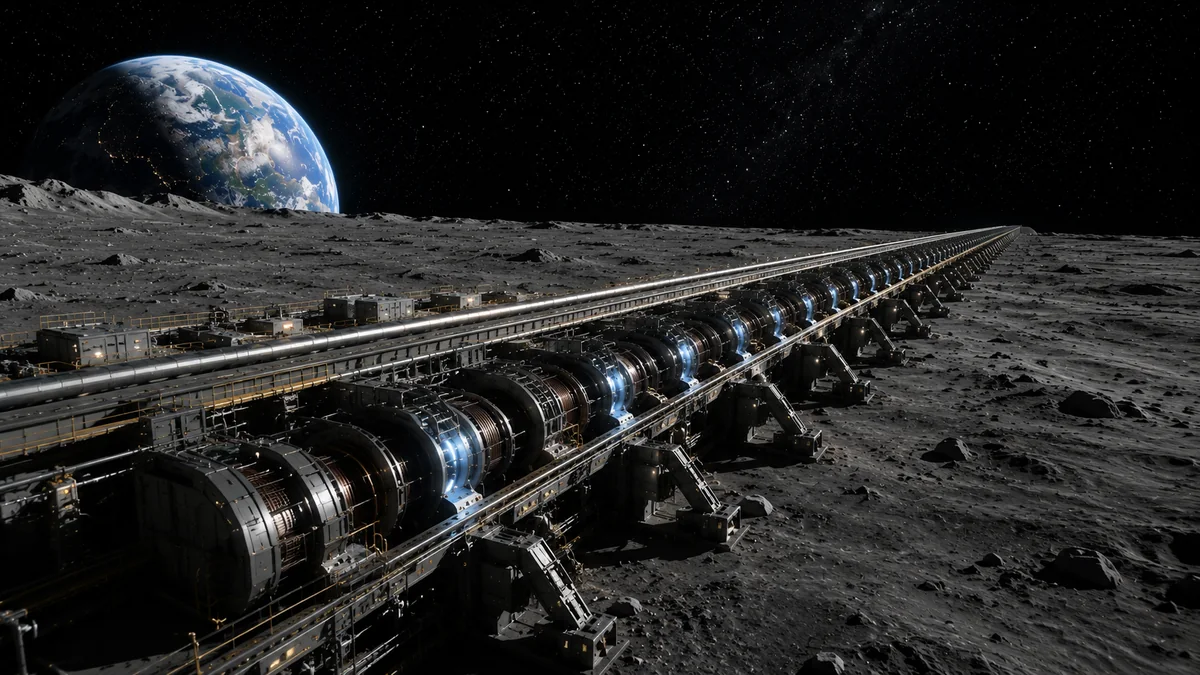
Some things escape because they’re pushed.
Some because they’re pulled.
And some reach a point where staying requires more force than leaving.
“Mass Driver” by The Gravity Problem is about that last one.
The song takes the physics of an electromagnetic launch system and turns it into a story about someone who has finally decided that escape isn’t something she hopes will happen to her.
She’s going to engineer it.
Low pulse in the black, coils hum like a prayer
My breath on the glass, no gods in the air
There is no rescue coming.
That’s important.
No divine intervention. No hero at the controls. No one arriving at the last moment to open the cage.
Just a machine charging in the dark.
And someone inside it who has already made her decision.
A machine built to throw things away
A mass driver is, fundamentally, an electromagnetic accelerator.
Instead of relying on combustion to accelerate a payload, the concept uses electromagnetic forces applied sequentially along a track. Energize the system in the right sequence and the payload is pulled or pushed forward, gaining velocity as it travels down the accelerator.1
Versions of the idea have been studied for moving material in space and launching payloads from low-gravity environments such as the Moon, where the absence of a substantial atmosphere and much lower escape velocity make electromagnetic launch particularly attractive.2
Which gives the opening verse its machinery:
Now the rail is alive, and the magnets awake
All the atoms of my body start to shake
But the machine isn’t the only thing waking up.
The narrator is too.
The accelerator becomes a physical representation of a decision that has already been building inside her.
Every energized coil is another step toward the point where returning becomes harder than continuing forward.
Under atmosphere
Before the machine activates, though, we learn why she needs it.
You kept me under atmosphere
Can’t imagine I’ll ever leave here
Called it love when the walls closed tight
Called me yours in the dying light
“Atmosphere” works literally in the language of launch.
It’s the environment surrounding the world you’re trying to leave.
But here it becomes something oppressive.
The atmosphere is the relationship. The expectations. The ownership. The environment she’s been breathing for so long that confinement has started masquerading as normality.
And then comes the line that changes gravity’s role:
I learned to sing with a chain across my chest
Soft as a wound, but I never confessed
Elsewhere in The Gravity Problem, gravity can be attraction. It can create stars. It can hold two things together.
In Mass Driver, gravity becomes the force insisting that something remain where it is.
The same property that can create stability can also make departure expensive.
Sometimes gravity is love.
Sometimes gravity is home.
And sometimes gravity is a cage.
Building an escape velocity
Count down in my bones, friction in my veins
If gravity is mercy, I’ll shed these chains
Escape velocity is the speed an object needs, in a simplified unpowered trajectory, to escape a body’s gravitational influence without falling back.
At Earth’s surface, that familiar number is about 11.2 kilometers per second.3
But there’s an important misconception hidden inside the phrase. A spacecraft doesn’t necessarily have to instantaneously reach 11.2 km/s and then coast away. A vehicle that continues receiving propulsion can escape while following a very different velocity profile.
What ultimately matters is having enough energy—and the right trajectory—to stop gravity from bringing you back.
I like that distinction for Mass Driver.
Freedom doesn’t necessarily arrive as one magical instant when the chains disappear.
Sometimes you just keep accelerating.
One decision.
Then another.
Then another.
Until eventually the thing behind you no longer has enough pull to determine where you go next.
And right before the launch:
Ya no me puedes detener…
You can’t stop me anymore.
It isn’t a threat.
It’s a status report.
The countdown has already reached zero.
Fire me out of the dark
Then the chorus launches.
Fire me out of the dark
No return, just a fading spark
All I was is burning behind
I become the speed of my own design
That last line may be the thesis of the entire song.
She’s no longer describing velocity as something happening to her.
She designed the trajectory.
She becomes its speed.
The mass driver stops being merely a machine and becomes agency.
And the fire isn’t propulsion.
It’s behind her.
All I was is burning behind
Her old life. The cage. The relationship. The version of herself that existed inside it.
Whatever happens to that world now is no longer her concern.
Let it burn.
There’s something deliberately ruthless about that moment. She isn’t escaping and then turning around hoping everything she left will understand.
She’s already accepted that it might all come apart.
The only thing that matters is that she isn’t in it anymore.
Radio ghosts
Leaving doesn’t necessarily make the old world silent.
It just makes it farther away.
Radio ghosts try to call my name
Static kisses through a hurricane
Your voice still claws at the edge of sleep
But it can’t reach me out here in the deep
Radio communication across the Solar System is possible precisely because radio waves can cross enormous distances through space.
But distance extracts a price.
As electromagnetic radiation propagates outward, its energy spreads across an increasingly large area. The received signal becomes weaker, which is why communicating with distant spacecraft requires enormous antennas, extremely sensitive receivers, precise pointing and sophisticated signal processing.4
NASA’s Deep Space Network exists to hear extraordinarily faint signals from spacecraft operating far beyond Earth.5
So the metaphor isn’t that the transmitter necessarily stopped broadcasting.
It may still be calling her name.
She’s just getting farther away.
The voice that once filled the room becomes a signal.
Then interference.
Then static.
Eventually, a ghost.
Payload, intent, and curse
I am payload, intent, and curse
Mass driver aimed through the universe
A payload normally doesn’t choose its destination.
It’s cargo.
Something else designs the mission, calculates the trajectory and launches it.
Not here.
She is simultaneously payload and intent.
The thing being launched and the reason for launching it.
Even “curse” works in two directions. She carries what happened to her, but she also becomes the last thing hurled back at the world that tried to keep her.
The weapon and the ammunition have become the same object.
Acceleration changes the chorus
Then something subtle happens.
The chorus returns, but the language has moved.
The first time:
All I was is burning behind
Now:
All I was is so far behind
The anger hasn’t necessarily disappeared.
But distance has begun doing its work.
The past isn’t burning anymore.
It’s simply far away.
And the next line tells us something even more important:
A zenith vector of my own design
A vector describes both magnitude and direction.6
Zenith is the direction directly overhead from an observer—the opposite direction from the local downward vertical toward the nadir.7
“Zenith vector” isn’t the name of some standard spacecraft maneuver. It’s poetic physics.
But it’s useful poetic physics.
Because escape only tells us what she’s leaving.
A vector tells us where she’s going.
Up.
Away.
With magnitude.
With direction.
And this time, chosen by her.
No hands on controls
No hands on controls, I let go of the blame
I lose what I was, but I don’t lose my name
That line initially sounds reckless.
Inside the mass-driver metaphor, it can mean something else entirely.
The accelerator determines the launch conditions. Once the payload leaves the track, the machine that accelerated it is behind.
The trajectory has already been established.
There comes a point where freedom requires accepting that you can’t keep one hand on the old controls.
You can’t leave while continuously steering yourself back toward the launch site.
She may lose the identity that existed there.
But not the part that was actually hers.
I lose what I was, but I don’t lose my name
That’s the distinction.
The vacuum doesn’t have a choir
Then the bridge deliberately stops caring about restraint.
I hear the choir in the vacuum rise
Violins shredding orbital cries
Scientifically, of course, there is a problem.
Space is effectively a vacuum, and ordinary sound requires a medium through which pressure waves can propagate.8
There is no literal choir traveling acoustically through interplanetary space.
But this isn’t a documentary.
This is the moment when the internal soundtrack becomes larger than the environment.
The symphonic elements swell. The machinery charges. The breakdown arrives.
And then she finally says everything she was too afraid to say before launch.
Not your possession, not your prophecy
Not the girl you buried under gravity
Now the metaphor names the crime.
Gravity wasn’t simply keeping her nearby.
It was burying her.
And the response comes in three declarations:
I am motion, I am wrath, I am release
Motion.
The physical state.
Wrath.
The emotional state.
Release.
The result.
Physics becomes emotion becomes freedom.
A pulsar bloom
Then:
A pulsar bloom erupting into peace
“Pulsar bloom” isn’t an astronomical term.
It’s imagery.
A pulsar is the rapidly rotating remnant of a massive star—a neutron star whose magnetic geometry can produce beams of electromagnetic radiation that sweep through space. When those beams cross our line of sight, we detect extraordinarily regular pulses.9
But the important word in the lyric isn’t really pulsar.
It’s peace.
The most violent moment in the song produces the calmest emotional state.
That’s deliberate.
The struggle wasn’t traveling away.
The struggle was reaching the point where she could finally allow herself to go.
The eruption is the release.
The signal turns red
By the final chorus, even the physics of observation joins the departure.
Fire me into the red shift
Beyond the sky, forever adrift
When a source of light moves away from an observer, its observed wavelengths can shift toward longer wavelengths—the phenomenon we call redshift.10
There are several physical mechanisms that produce redshift in astronomy, including the expansion of the universe and gravitational effects, but the version that matters to this metaphor is motion away from the observer.
If the narrator becomes the source, then redshift turns departure into something measurable.
The world behind her doesn’t merely watch her getting smaller.
Her signal itself says:
I’m moving away from you.
And the farther the song travels, the less emotional energy remains attached to what was left behind.
First:
All I was is burning behind
Then:
All I was is so far behind
Finally:
No return, just fading memoirs
All I was, all my old loyalties
That’s the emotional trajectory hiding inside the three choruses.
Burning → distance → memory.
The physical separation and emotional separation increase together.
The machine was never the freedom
Eventually the coils go quiet.
Coils fade in the endless blue
Nothing left of the cage I knew
Breath by breath, I disappear
Far from the pull, beyond the fear
I think that’s where the entire metaphor resolves.
The mass driver isn’t freedom.
The magnets aren’t freedom.
Acceleration isn’t even freedom.
They’re mechanisms.
They exist to change the narrator’s trajectory.
Once they’ve done that, she doesn’t need to carry the machine with her.
That’s why the song begins with coils humming like a prayer and ends with those same coils fading into the distance.
The thing that saved her isn’t where she belongs either.
It was simply what gave her enough momentum to leave.
Freedom isn’t the machine.
It’s reaching the point where the forces that once decided your orbit no longer get to determine your destination.
And then continuing forward anyway.
Sources & Further Reading
1. NASA Technical Reports Server — Mass-driver and electromagnetic-launch concepts. NASA’s technical literature includes studies of electromagnetic systems for accelerating payloads without conventional chemical propulsion. Search NASA NTRS ↩
2. NASA Technical Reports Server — Lunar electromagnetic launch concepts. Technical studies have examined electromagnetic launchers for moving material from the lunar surface, where low gravity and negligible atmosphere make the concept particularly attractive. Search NASA NTRS ↩
3. NASA Glenn Research Center — Escape Velocity. Explanation of escape velocity and the approximately 11.2 km/s value at Earth’s surface. Read at NASA ↩
4. NASA/JPL — Basics of Space Flight: Telecommunications. How spacecraft communication links contend with distance, weak received signals, antennas and radio-frequency propagation. Read at NASA/JPL ↩
5. NASA Jet Propulsion Laboratory — Deep Space Network. NASA’s worldwide antenna network for communicating with distant robotic spacecraft. Read at NASA/JPL ↩
6. NASA Glenn Research Center — Scalars and Vectors. A vector quantity contains both magnitude and direction. Read at NASA ↩
7. Encyclopaedia Britannica — Zenith. Zenith is the point in the sky directly above an observer, opposite the nadir. Read at Britannica ↩
8. NASA — Sound in Space. Ordinary acoustic sound requires matter through which pressure waves can travel; the near-vacuum of space cannot transmit sound as an atmosphere does. Read at NASA ↩
9. NASA Science — Neutron Stars and Pulsars. Pulsars are rapidly rotating neutron stars whose beams of radiation can sweep across our line of sight as regular pulses. Read at NASA Science ↩
10. NASA Science — Redshift. Astronomical redshift includes the shift toward longer wavelengths associated with a source moving away from an observer. Read at NASA Science ↩