TRANSMISSION 26.011
Kilonova: We Died So Worlds Could Live
Inside “Kilonova” by The Gravity Problem: how core collapse, magnetars, neutron-star mergers, gravitational waves and rapid neutron capture turn the deaths of two stars into the birth of gold, platinum and some of the heaviest elements in the universe.
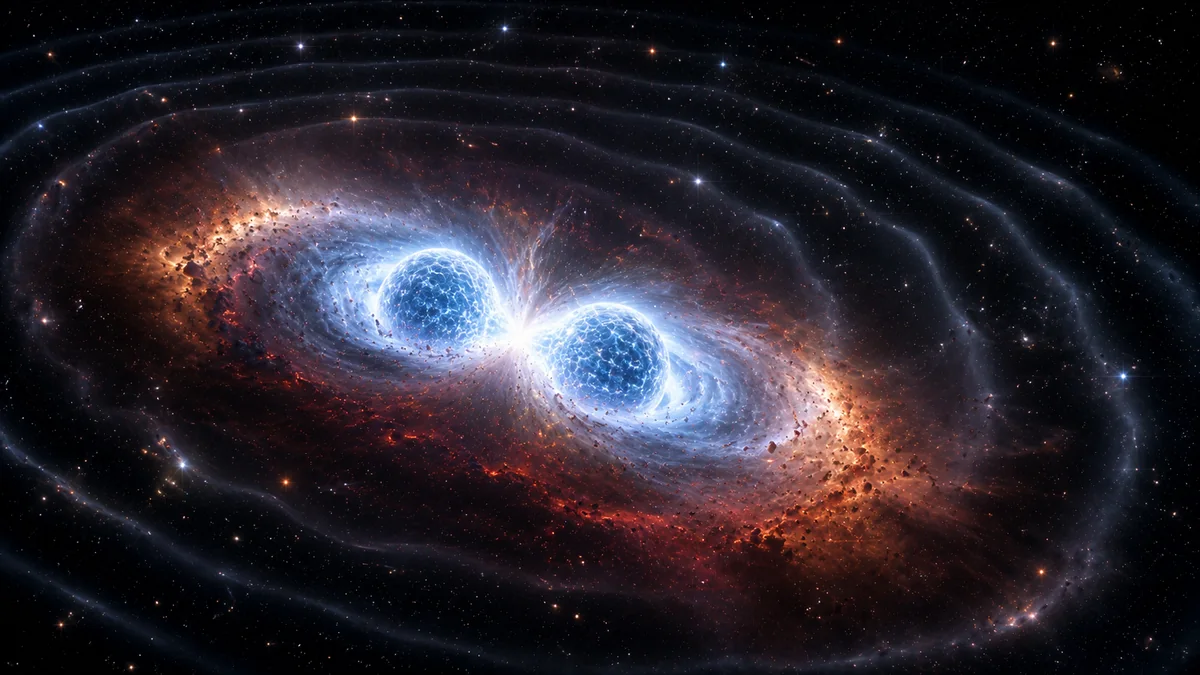
Some songs in The Gravity Problem take astrophysics and turn it into metaphor.
“Kilonova” mostly lets astrophysics speak for itself.
Because if you describe the actual sequence honestly enough—a massive star exhausting its fuel, its core collapsing into nuclear-density matter, a neutron star awakening with an almost incomprehensible magnetic field, two stellar corpses spiraling toward one another while radiating gravitational waves, and their final collision manufacturing some of the heaviest elements in existence—
you don’t really need to make it more metal.
The universe already did that.
Iron heart exhausted
The song begins with a status report.
Iron heart exhausted…
Fuel consumed…
Gravity… take me.
For most of a massive star’s life, there is a struggle happening inside it.
Gravity pulls inward.
The pressure generated by the hot interior pushes outward.
As long as the star can maintain that balance, it survives.
But massive stars progressively fuse lighter nuclei into heavier ones. Hydrogen becomes helium. Later stages can produce carbon, oxygen and successively heavier elements until the core becomes dominated by iron-group nuclei.
And iron changes the game.
Iron lies near the peak of nuclear binding energy per nucleon. Fusing iron into still-heavier nuclei doesn’t provide the net energy release that earlier fusion stages did.1
The star has effectively run out of profitable nuclear moves.
Gravity hasn’t suddenly arrived.
Gravity was there the entire time.
The star has simply lost the energy source that had been holding it off.
Which gives us:
No more fire beneath my skin
Only iron locked within
The iron isn’t merely another stage.
It’s the bill coming due.
Gravity finally wins
Stellar core begins to cave
Nothing left for light to save
Gravity claims what time denied
Crushing worlds from deep inside
Once the iron core of a sufficiently massive star can no longer support itself, the collapse becomes extraordinarily rapid.
Electrons are driven into protons, producing neutrons and neutrinos. Matter is compressed toward nuclear densities. The inner core collapses and stiffens dramatically while the outer core continues falling inward.
The details of how that collapse produces a successful supernova explosion are complicated—neutrino transport, shock dynamics and multidimensional effects all matter—but the result can be one of the most violent events in the universe: a core-collapse supernova.2
Which makes:
A collapse heard the universe over
The first breath of the supernova
poetic rather than literal.
There is no acoustic boom traveling through the vacuum for the universe to hear.
But the catastrophe absolutely sends information outward.
Electromagnetic radiation.
Neutrinos.
And potentially gravitational waves.
The universe gets the message.
The silence before the scream
Implosion—
The silence before the scream
Gravity—
Turns a dying sun obscene
That word—implosion—matters.
When people picture a supernova, they naturally picture the explosion.
But first comes collapse.
The core falls inward.
Only then does the event become something spectacularly outward.
That reversal is part of what makes core-collapse supernovae so violent conceptually.
The star’s final explosion begins with something inside it losing the ability to resist gravity.
Then the core left behind becomes something almost impossible to comprehend.
Twenty kilometers holding a sun
Born from the wreckage, no more facade
Forged into matter, colder than a god
Twenty kilometers holding a sun
Neutron heart…
The collapse has begun
A neutron star can pack more mass than our Sun into an object only about 20 kilometers across.3
That’s roughly the scale of a city.
A star dies.
Its outer layers are expelled.
And its core becomes an object in which matter has been compressed into an entirely different regime.
Neutron-star density is so extreme that familiar comparisons become ridiculous almost immediately. A tiny volume of neutron-star matter, if somehow transported intact to Earth, would have an astronomical mass by everyday standards.
This isn’t merely very dense rock.
It isn’t even remotely close.
It’s matter pushed toward nuclear density on a macroscopic scale.
The star hasn’t simply become smaller.
It has become something else.
Awaken
Then the song gives the remnant one word:
Awaken…
Magnetar
A magnetar is a neutron star distinguished by an extraordinarily intense magnetic field.
Typical magnetar surface fields can reach roughly (10^{14}) to (10^{15}) gauss—among the strongest magnetic fields known in the universe.4
So when the narrator announces:
A thousandfold stronger than stars before
she isn’t exaggerating by the standards of ordinary stellar magnetic fields.
The numbers involved are absurd.
And the consequences become even stranger.
Atoms bend where my fingers reach
Reality twists at my magnetic core
Atoms bend where my fingers reach
Natural law, overreach
Magnetic fields this extreme can influence matter in ways that bear little resemblance to our everyday experience.
Atomic structures can become strongly distorted. The behavior of electrons changes. Quantum electrodynamic effects that are negligible under terrestrial conditions can become astrophysically important.
And that’s why I like:
Natural law, overreach
because the magnetar isn’t actually violating natural law.
It’s doing something better.
It’s obeying natural law in a regime so extreme that ordinary intuition stops being useful.
That’s a recurring idea throughout The Gravity Problem.
The universe doesn’t need to break physics to become unbelievable.
Physics is already strange enough.
Matter kneels
Matter kneels beneath my reign
Invisible chains become my domain
Magnetic fields are invisible.
Their effects aren’t.
Charged particles respond to them. Plasma follows magnetic structures. Radiation behaves differently in extreme fields.
The narrator naturally interprets all of this as power.
She died as a star.
She woke up as something smaller.
And somehow became more terrifying.
Which is when the crust breaks.
STARQUAKE!
The crust breaks…
STARQUAKE!
Gamma rays go flying
Constellations dying
Yes.
Neutron stars can have crusts.
And yes, starquake is a real term used to describe sudden fractures or rearrangements associated with neutron-star crusts and magnetic stresses.
Magnetars can produce powerful bursts of X-rays and gamma rays, including rare giant flares energetic enough to be detected across enormous astronomical distances.5
So I didn’t have to invent much for this breakdown.
The universe already gave metal the word STARQUAKE.
I just used it.
“Constellations dying,” on the other hand, can stay firmly in the narrator’s theatrical imagination.
A magnetar flare isn’t ordinarily deleting constellations from the Galaxy.
She just survived core collapse and woke up with one of the strongest magnetic fields in existence.
I’ll allow her some swagger.
Then she sees another corpse
After all of that violence, the story changes.
Then I saw another flame
Forged in suffering just the same
A mirrored corpse of gravity
Bound forever…
Only she
Now there are two neutron stars.
Two remnants of stellar catastrophes.
Two objects that only exist because their original stars lost the fight against gravity.
And they’re gravitationally bound to one another.
That’s where Kilonova stops being primarily about stellar death.
Now it’s about the orbit.
Every orbit steals separation
Round and round eternity
Every orbit stealing speed
Closer now than light can flee
Destined by relativity
There is a small poetic liberty in “every orbit stealing speed.”
A compact binary system doesn’t simply lose orbital speed as the stars spiral inward.
Something more interesting happens.
General relativity predicts that accelerating masses can generate gravitational waves—propagating disturbances in spacetime itself.
A neutron-star binary radiates energy and angular momentum through those waves.
As orbital energy is lost, the separation between the stars shrinks.
Their orbital period decreases.
And as they spiral closer, they move around one another increasingly rapidly.
So the thing every orbit is really stealing is:
distance.
The orbit tightens.
The frequency rises.
The gravitational-wave signal climbs.
The clock runs out.
Destined by relativity
Destined by relativity
That’s barely metaphorical.
Einstein’s general theory of relativity predicts gravitational radiation, and compact binary systems are among its most spectacular sources.6
Neutron stars are ideal ingredients.
They’re massive.
They’re extraordinarily compact.
And near merger, they’re orbiting each other at astonishing speeds.
As the separation shrinks, the gravitational-wave signal becomes stronger and faster.
The stars aren’t merely falling toward each other.
Spacetime is carrying away the energy that would have allowed them to remain apart.
Then the chorus says what the equations already know:
Draw me closer
Orbit tighter
Every second burning brighter
Spiral inward
Gravity knows
Only one way this story goes
There is no stable ending left in the orbit.
The merger is coming.
KILONOVA
Then it happens.
No horizon
No surrender
Matter tears itself asunder
Worlds collide
The heavens break
The universe begins to shakeKILONOVA!
When two neutron stars merge, the collision can eject neutron-rich material at enormous velocities.
The resulting radioactive ejecta can produce a transient called a kilonova.
The light isn’t primarily powered by ordinary stellar fusion.
It’s powered by the radioactive decay of freshly synthesized unstable nuclei created in the neutron-rich material expelled by the merger.7
And this is where the story becomes extraordinary even by neutron-star standards.
Because the collision doesn’t merely destroy.
It manufactures.
Rapid neutron capture
The second breakdown is essentially an astrophysics lecture being screamed over guitars.
Rapid neutron capture
Faster than decay
That’s almost the definition.
The r-process is the rapid neutron-capture process.
In an environment with an enormous neutron flux, atomic nuclei capture neutrons so rapidly that additional captures can occur before the unstable nuclei have enough time to undergo radioactive beta decay.
The nuclei are driven far into neutron-rich territory.8
So:
Billions of collisions, forging life from rage
is the narrator getting dramatic again.
But:
Neutron flood
is exactly the environment we need.
Then silence falls
Eventually the neutron bombardment ends.
The nuclei are left extraordinarily neutron-rich and unstable.
Then:
Beta decay answers the calls
Neutrons become…PROTONS!
Yes.
In beta-minus decay, a neutron transforms into a proton while emitting an electron and an electron antineutrino.
And changing a neutron into a proton changes the nucleus’s atomic number.
That means it changes which element the atom is.
The breakdown is essentially narrating unstable nuclei climbing toward more stable configurations on the periodic table.
Which makes the next screamed word completely appropriate.
HEAVIER!
Gold
Then the periodic table starts arriving one element at a time.
Gold!
Platinum!
Thorium!
Uranium!
Europium!
This is the part that sounds most like science fiction and may actually be the least fictional section of the entire song.
Neutron-star mergers are now recognized as major astrophysical sites of r-process nucleosynthesis, capable of producing many elements heavier than iron—including precious metals and heavy radioactive nuclei.9
Gold.
Platinum.
Lanthanides such as europium.
And nuclei extending into the actinides under appropriate conditions.
The violence isn’t merely producing light.
It’s building atoms that couldn’t easily be manufactured through ordinary stellar fusion.
The night we watched it happen
Then, in 2017, humanity caught one.
On August 17, 2017, the LIGO and Virgo gravitational-wave observatories detected a signal designated GW170817.
It came from the inspiral and merger of two neutron stars roughly 130 million light-years away.
Then telescopes detected electromagnetic radiation from the same event.
Gamma rays.
Optical light.
Infrared.
X-rays.
Radio.
For the first time, astronomers had observed a neutron-star merger through both gravitational waves and electromagnetic radiation.10
This was multimessenger astronomy in spectacular form.
And the kilonova that followed provided compelling observational evidence that neutron-star mergers manufacture heavy r-process elements.
For Kilonova, GW170817 is essentially the real-world event that validates the song’s entire final act.
Two neutron stars spiral inward.
Spacetime carries the warning.
They merge.
A kilonova appears.
Heavy elements are forged.
The universe did it first.
Every ring you’ve ever worn
Then the song gets carried away.
Every ring you’ve ever worn
Every crown that’s ever shone
Every atom called your own
Was born inside our final home
The first two lines are wonderfully close to the astrophysical point.
Much of the gold and other heavy r-process material incorporated into the Solar System ultimately came from violent astrophysical nucleosynthesis events before the Sun and planets formed.
But:
Every atom called your own
is too generous.
The narrator has just manufactured gold and is understandably feeling important.
I’ll allow the bragging.
Scientifically, the atoms making up a human body have many different origins.
Most hydrogen traces back to primordial nucleosynthesis in the early universe.
Carbon, oxygen and many other biologically important elements were forged through generations of stars.
Iron-group elements have their own stellar and explosive nucleosynthetic histories.
And astrophysicists continue studying how much of the universe’s r-process inventory comes from neutron-star mergers versus other possible sites.
Cosmic ancestry is messy.
That’s part of what makes it beautiful.
There isn’t one furnace responsible for everything.
The universe has been recycling matter through different environments for billions of years.
We died so worlds could live
Then the narrator stops listing elements.
We died
So worlds could live
We burned
So stars could give
That’s the real resolution.
The neutron stars don’t survive the merger in their original forms.
Depending on the masses and conditions involved, the merger can produce a more massive neutron star, perhaps temporarily, or collapse into a black hole.
But some material can be thrown outward.
That material carries newly synthesized heavy nuclei into space.
Over cosmic time, enriched material can become incorporated into later generations of stars and planetary systems.
Eventually, atoms forged in catastrophe can become part of worlds that didn’t exist when the catastrophe happened.
A violent ending becomes somebody else’s periodic table.
Destruction and creation aren’t opposites
That’s a theme that keeps returning throughout The Gravity Problem.
A cloud collapses and a star ignites.
Two bodies cross the Roche limit, break apart and become something new.
A comet loses material and becomes visible.
A star dies and leaves behind a neutron star.
Two neutron stars die again—
and create gold.
The universe has very little respect for the clean line humans like to draw between destruction and creation.
Often they’re not opposites.
They’re consecutive processes.
One configuration ends.
The material continues.
Something else becomes possible.
Gravitational waves through all
Then the final lyric gives us one last messenger:
Across forever
Hear our call
Gravitational waves…
Through all.
Gravitational waves aren’t light.
They’re propagating distortions in spacetime itself.
The waves from GW170817 traveled for roughly 130 million years before passing through Earth.
Think about that.
The neutron stars collided around 130 million years before anyone here knew it happened.
The signal crossed intergalactic space.
Earth changed.
Species evolved.
Continents moved.
Humans appeared.
Physics developed.
Einstein wrote down general relativity.
Scientists eventually built instruments sensitive enough to measure changes in distance smaller than a proton over kilometer-scale detectors.
And then—
the wave arrived.
For a fraction of a second, two machines on Earth listened to spacetime change shape.
The stars were long gone.
But gravity was still carrying the news.
We died so worlds could live
Kilonova is a song about stellar death.
But almost nothing in it actually ends.
A massive star dies and leaves a neutron star.
The neutron star becomes something more extreme.
Two stellar remnants find one another.
Their orbit becomes gravitational waves.
Their collision becomes a kilonova.
Their neutrons become heavier nuclei.
Their radioactive decay becomes light.
Their debris becomes material available to future stars and planets.
Their gold becomes rings.
Their platinum becomes artifacts.
Their europium becomes part of worlds that did not exist when the atoms were forged.
And their gravitational signal crosses the universe long after the original bodies are gone.
At every stage, one ending becomes somebody else’s raw material.
So when the final chorus says:
We died
So worlds could live
that’s not merely metaphor.
It’s uncomfortably close to the way the universe actually works.
Stars die.
Matter continues.
Gravity carries the news.
And somewhere much later, something made from the wreckage looks up—
wearing a little piece of the catastrophe on its hand—
and finally understands where its gold came from.
Sources & Further Reading
1. NASA Science — Stellar Evolution. Massive stars progressively fuse heavier nuclei until iron-group elements accumulate and fusion can no longer provide net energy support. Read at NASA Science ↩
2. NASA Science — Supernovae. Background on core-collapse supernovae and the violent end stages of massive stars. Read at NASA Science ↩
3. NASA Science — Neutron Stars. Neutron stars can contain more mass than the Sun in an object only about 20 kilometers across. Read at NASA Science ↩
4. NASA Science — Magnetars. Magnetars are neutron stars with extraordinarily intense magnetic fields, among the strongest known in the universe. Read at NASA Science ↩
5. NASA — Magnetar Flares and Starquakes. Magnetars can undergo violent crustal and magnetic rearrangements associated with powerful X-ray and gamma-ray outbursts. Explore NASA Science ↩
6. LIGO — Gravitational Waves. Accelerating compact masses such as neutron-star binaries emit gravitational radiation, carrying energy and angular momentum from the system. Read at LIGO ↩
7. NASA Science — Kilonovae and Neutron-Star Mergers. Radioactive decay in neutron-rich ejecta from compact-object mergers powers kilonova emission. Explore NASA Science ↩
8. U.S. Department of Energy — r-Process Nucleosynthesis. The rapid neutron-capture process builds highly neutron-rich nuclei faster than they can beta-decay. Read at DOE ↩
9. NASA — Heavy Elements from Neutron-Star Mergers. Neutron-star mergers are major sites for the creation of r-process elements including gold, platinum and lanthanides. Explore NASA ↩
10. LIGO/Virgo — GW170817. The 2017 binary-neutron-star merger was detected in gravitational waves and across the electromagnetic spectrum, establishing a landmark multimessenger observation and providing strong evidence for heavy-element production in kilonova ejecta. Read at LIGO ↩