TRANSMISSION 26.001
Inside The Gravity Problem: Building a Universe From Science and Metal
Inside The Gravity Problem, a cinematic space-metalcore project where real physics becomes metaphor: the science, songwriting, AI performance, and creative decisions behind the debut album.
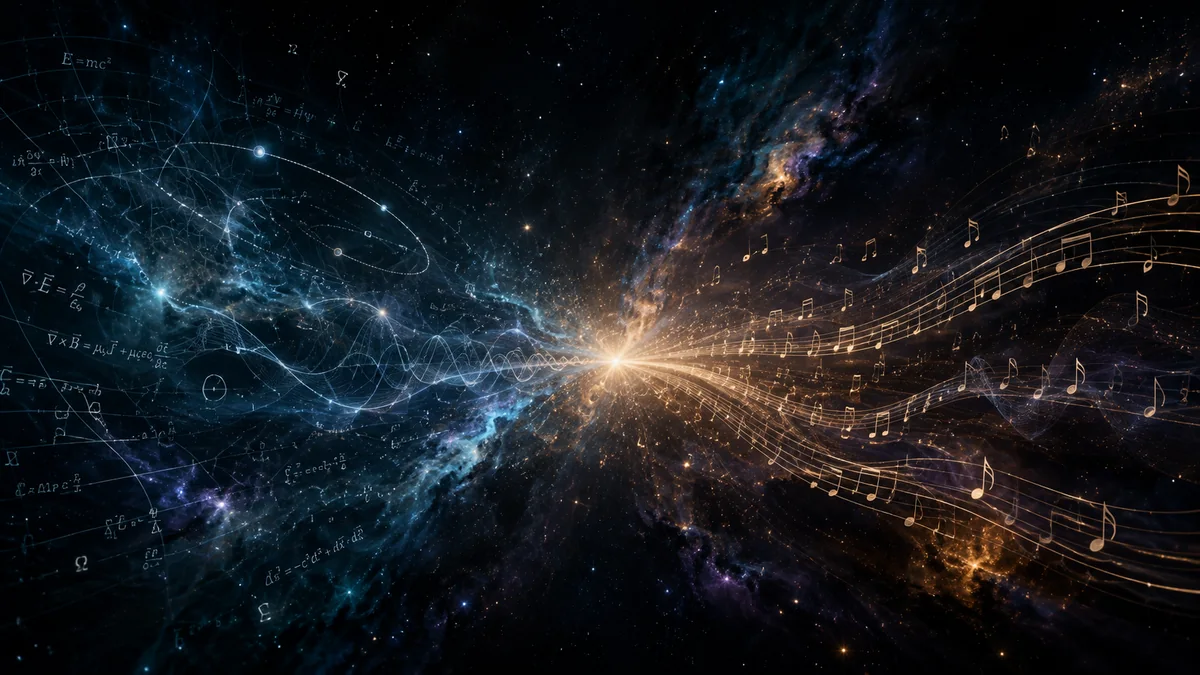
I don’t remember deciding that physics should become metaphor.
I think I had already been doing it for years.
The Gravity Problem is a cinematic space-metalcore project built around a simple idea: the forces that shape the universe can also describe the forces that shape us.
I’ve always been drawn to the same handful of things: music, science fiction, space, real science, books, and the enormous questions that tend to live somewhere between them. Give me a documentary about black holes, a book about the edge of the observable universe, or a song that sounds like it belongs somewhere beyond Earth, and I’m probably paying attention.
At some point, though, I realized I wasn’t just learning about these things.
I was translating them.
Distance wasn’t only distance anymore. An orbit could describe a relationship. Gravity could become attraction. A changing frame of reference could explain why two people could experience the same reality and walk away from it with completely different truths.
The universe had quietly become a vocabulary for things that were much more human.
Finding the right format
I’ve tried writing longer stories before. The problem is that my imagination has a tendency to outrun the page.
I’ll start writing a scene, begin seeing it too clearly in my head, and before long I’m more interested in creating the image than finishing the chapter. One idea branches into another. The world keeps expanding. The story remains unfinished.
A song imposes boundaries.
A few minutes. A handful of verses. A chorus. Maybe a breakdown.
You have enough room to build a world, introduce an idea, make someone feel something—and then you have to land it.
That turned out to be exactly the constraint I needed.
Once I started writing songs this way, I couldn’t stop. One scientific idea suggested another. One metaphor opened the door to the next. Before long, what had begun as individual songs started revealing a larger universe of its own.
That became The Gravity Problem.
Building the voice
Once I found the format, I poured that creative energy into the lyrics and musical composition—shaping the structures, instrumentation, dynamics, vocal delivery and atmosphere around each story.
But The Gravity Problem needed more than songs. It needed a recognizable voice.
I began developing a performance identity specifically for this universe: a warm, husky Puerto Rican female vocalist capable of moving between intimate, breathy passages, powerful melodic vocals and the screams and gutturals that metalcore demands. Subtle Latin rhythmic influences became part of the musical vocabulary as well.
That performer is an AI persona.
I don’t consider that something to hide or something listeners should have to discover later. The Gravity Problem is a human-created music project performed through AI-generated voices and instrumentation. I write the lyrics, develop the musical compositions and arrangements, define the performances, and shape the creative direction; generative tools are part of how those ideas become finished recordings.
In some ways, that freedom made the project larger. I wasn’t writing around the limitations of musicians who happened to be available to me. I could ask instead:
What should this universe sound like?
Then I could build toward the answer.
The science has to mean something
The science on this album isn’t there because scientific terminology sounds futuristic.
The underlying concept needs to be real, and then it needs to have something human to say.
Dust of Dreams looks toward the birth of stars: matter scattered across enormous distances, gathering under gravity until something new finally ignites. But underneath the astrophysics is a story about possibility—about the things that can emerge from what once looked like nothing more than dust.
Frame Shift plays with frames of reference: the idea that observation depends on where you are, how you’re moving, and the perspective from which you measure something. The physics becomes a way to talk about human perception—how the same people, the same moment, even the same molecules can occupy a different state depending on the frame through which they’re understood.
Then there is Roche Limit.
In orbital mechanics, the Roche limit marks the distance at which the tidal forces exerted by one body can overcome the gravity holding another together. Get close enough, and the old structure can no longer survive.
The song begins with two people already settled into their own separate orbits. Then they encounter each other.
They feel the attraction. They know where the trajectory leads. Getting closer means surrendering the stability of the lives they already have—and neither of them is pretending the collision will be gentle.
They choose it anyway.
Crossing the Roche limit pulls apart what they were before. Their old orbits collapse. They collide. But destruction isn’t the end of the metaphor.
Gravity is still there.
What was torn apart comes together again—not as two bodies returning to their previous paths, but as something new:
one body burning in one design, same orbit.
That’s what interested me about the science. Sometimes attraction doesn’t preserve the structures it acts upon. Sometimes it destroys them, rearranges them, and creates an entirely different configuration.
And sometimes being pulled apart is exactly what makes you feel alive.
That is the territory I wanted the album to occupy: the point where an equation stops being merely an equation.
What should space sound like?
The music itself came from the same collision of influences.
Most of the bands that have stayed with me over the years live somewhere in metal, metalcore, or heavy rock. And whenever one of those bands ventured into space—whether lyrically, sonically, or just atmospherically—those songs tended to grab me particularly hard.
So when these ideas began becoming songs, heavy music was never really a question.
But heaviness alone wasn’t enough.
The album needed to feel as though these stories actually belonged in the environment they described: enormous distances, empty space, radio signals, machinery, gravity, isolation, violence, beauty.
That led toward what I eventually began calling cinematic space-metalcore: down-tuned guitars and breakdowns against atmospheric synths, industrial textures, deep low end, and enough empty space in the arrangements to make the scale feel larger than the band.
That performance identity also changes the emotional temperature of the music.
There are personal connections behind the Puerto Rican voice and subtle Latin rhythmic influences, but more importantly, I believed that warmth and rhythmic character would create an interesting contrast against an environment that could otherwise become cold, mechanical and sterile.
Space provides the scale.
The voice provides the humanity.
Oxygen is precious
That voice also led to one of my favorite small rules in the world of The Gravity Problem.
Listen closely to some of the quieter moments and intros and you’ll hear breath.
That is deliberate.
In space, oxygen isn’t background scenery. It’s a resource. Every breath matters.
So I began thinking about the vocalist in the same way.
If she’s somewhere out there using precious oxygen to tell you a story, perhaps the story matters enough to hear.
It’s a tiny piece of world-building. Plenty of listeners may never consciously notice it, and that’s fine. Not every idea needs to announce itself.
Sometimes it just needs to make the universe feel a little more real.
The universe unfolds
That may be the best explanation I can give for how this album came together.
I didn’t begin with a checklist of astronomical phenomena and decide to write songs about them. I started noticing how often the universe was already describing things I understood.
Attraction. Distance. Perspective. Collapse. Resonance. Time. Destruction. Creation.
Physics gave those ideas structure.
Music gave them somewhere to go.
And once I found that intersection, the universe just kept unfolding.
Real science provides the vocabulary. Metalcore provides the force.