TRANSMISSION 26.003
Dust of Dreams: How Nothing Becomes Something
Inside “Dust of Dreams” by The Gravity Problem: how collapsing molecular clouds become stars—and why stellar formation became a metaphor for the moment scattered ideas finally ignite into something real.
The song begins with a lie.
From nothing, we gather the light
Not a scientific lie.
A human one.
Stars don’t come from nothing. They form inside enormous molecular clouds containing gas, dust, molecules and enough raw material to produce entire populations of stars. Some of these clouds span hundreds of light-years. Their densest regions can eventually collapse under their own gravity and begin the long process of stellar formation.1
But “nothing” means something different when you’re trying to create.
Nothing is the blank page.
The unfinished thought.
A phrase you wrote down without knowing why.
An image that won’t leave your head.
A rhythm without a song around it.
Individually, none of those things may amount to much.
Then something starts pulling them together.
That’s where “Dust of Dreams” by The Gravity Problem begins: with the birth of a star on one level and the birth of an idea on another.
Both start scattered.
Both need gravity.
Before there was light
Before the blanket of the ocean
Before the world first burned in flame
There was only velvet pressure
Tiny ghosts in all but name
Long before a planet can have oceans, there must first be a star for that planet to orbit.
Stars begin in some of the coldest environments in the universe: molecular clouds composed predominantly of gas with comparatively tiny amounts of interstellar dust mixed throughout. Webb observations probe clouds that can reach temperatures around 10 kelvin—roughly −263 °C.2
They aren’t empty.
But they can be astonishingly diffuse by everyday standards.
That’s why I liked the idea of tiny ghosts.
There is matter everywhere, but nothing resembling the object it may eventually become.
Then gravity gets involved.
Silent grains in endless motion
Pulled by hunger trying to reframe
Cold material can collect into denser pockets. As a region gains mass, its gravitational influence grows. Eventually gravity can overcome the forces resisting collapse and the cloud begins contracting inward.1
The hunger in the song is gravity.
It doesn’t know what it’s making.
It just pulls.
With graviton leisure
Then there is this line:
Motes condense with graviton leisure
This is one of the places where Dust of Dreams intentionally steps from established astrophysics into theoretical physics.
Gravity is real.
The graviton remains hypothetical.
In attempts to describe gravity quantum mechanically, a graviton would be the quantum associated with the gravitational interaction. No graviton has been detected, and physics does not yet possess a complete experimentally verified quantum theory of gravity.3
So no, astronomers aren’t watching gravitons leisurely herd dust into stars.
I just love the idea.
The lyric takes something overwhelmingly slow and enormous—gravity gathering diffuse material over astronomical timescales—and imagines the hypothetical messenger of gravity going calmly about its work.
No urgency.
Just inevitability.
Let gravity make us real
As the cloud collapses, something profound happens.
Material falls inward. The collapsing region becomes denser. Its center heats. Rotation helps organize infalling matter into a disk.
Eventually a protostar develops at the center.4
It’s not yet a star in the stable main-sequence sense.
But the cloud has crossed an important conceptual boundary.
It has a center now.
Something that was dispersed across space has become an object.
That’s why the most important line in the chorus may be:
Let gravity make us real
Gravity doesn’t create the material.
It creates the relationship between the material that allows something new to emerge.
That’s also the creative metaphor underneath the song.
An isolated phrase isn’t necessarily a song.
Neither is a riff.
Neither is an image, an emotion, a scientific idea or a rhythm.
But gather enough of them around the same center and eventually the fragments begin exerting their own pull.
The project starts telling you what belongs.
A star in the teeth of fathomless pressure
Collapse doesn’t stop simply because a protostar has appeared.
Material continues feeding inward through the surrounding disk. The protostar gains mass, and its interior becomes progressively hotter and denser. During this early stage, much of its energy comes from gravitational contraction rather than sustained hydrogen fusion.5
Then comes the threshold.
Millions of degrees.
Immense pressure.
Hydrogen nuclei finally begin fusing into helium.
Fusion releases energy, generating the outward pressure capable of resisting further gravitational collapse. A stable main-sequence star has effectively switched on.6
Which turns this:
A star in the teeth of fathomless pressure
A fire dragged out of the night
into a pretty good description of what gravity has accomplished.
The pressure wasn’t incidental.
The pressure was necessary.
The universe isn’t quiet while this happens
Nebula veins in ultraviolet
Curl like breath across the deep
Radio scars and frozen thunder
Wake the things that never sleep
One of my favorite things about star-forming regions is that human eyesight gives us only part of the story.
Dense dust can obscure newborn stars at visible wavelengths. That’s why astronomers study stellar nurseries across the electromagnetic spectrum. Infrared observations can penetrate obscuring dust; radio observations can trace cold molecular material; ultraviolet radiation from young massive stars can ionize and reshape surrounding gas.7
The universe isn’t painting its nebulae specifically for us.
We build instruments that translate otherwise invisible information into something we can understand.
Which gives the lyric another connection to creativity:
Some structures only become visible when you learn how to look at them.
Then the song gives itself away
Verse two eventually stops pretending this is only about astronomy.
Ideas collide like shattered comets
Mass becomes a beating core
Swirling masses writing their own sonnets
Give in to hunger, become something more
There it is.
The metaphor steps directly into the foreground.
This is how Dust of Dreams itself came into existence.
Science collided with imagery.
Imagery collided with language.
Language collided with rhythm and instrumentation.
Fragments that didn’t necessarily belong together began accumulating around one idea until the idea developed enough gravity to organize them.
Eventually there was a core.
And once that happens, creation becomes strangely self-propelling.
You stop asking what the thing could be.
You start discovering what it already wants to become.
The frisson of ignition
Then comes possibly the strangest phrase on the album:
A piloerection frisson of creation
It’s deliberately excessive.
Piloerection is the physiological raising of the hairs on your skin.
Frisson is that sudden pleasurable chill—the goosebumps response that music, art or an emotionally powerful moment can sometimes trigger.
Put them together and the line describes something very specific:
the physical sensation of realizing an idea is working.
Anyone who creates things probably knows the moment.
You’ve been moving pieces around without knowing whether they belong together.
Then something clicks.
A lyric lands.
A chord change resolves.
An image suddenly becomes clear.
And your body reacts before you’ve finished intellectually understanding why.
For the human side of Dust of Dreams, that’s ignition.
Pressure is mercy
The bridge stops resisting collapse entirely.
Crush me down till I become
The heat inside a newborn sun
Tear me apart, let the fragments align
Pressure is mercy in the language of time
That last line contains most of the song.
Pressure usually sounds destructive.
Here it is constructive.
Without gravitational collapse, the molecular cloud can remain a molecular cloud.
Without enough pressure and temperature, hydrogen fusion never begins.
Without constraints, decisions and the willingness to discard things that don’t belong, creative fragments can remain fragments forever.
Sometimes pressure isn’t what destroys the idea.
It’s what finally gives the idea a shape.
Thunder inside the womb
A forming protostar doesn’t merely swallow everything around it.
Material falling inward tends to form a rotating disk. Young stellar systems can also launch narrow, high-speed bipolar jets roughly perpendicular to that disk. Those jets can collide with surrounding gas and dust, producing glowing shock structures called Herbig-Haro objects.8
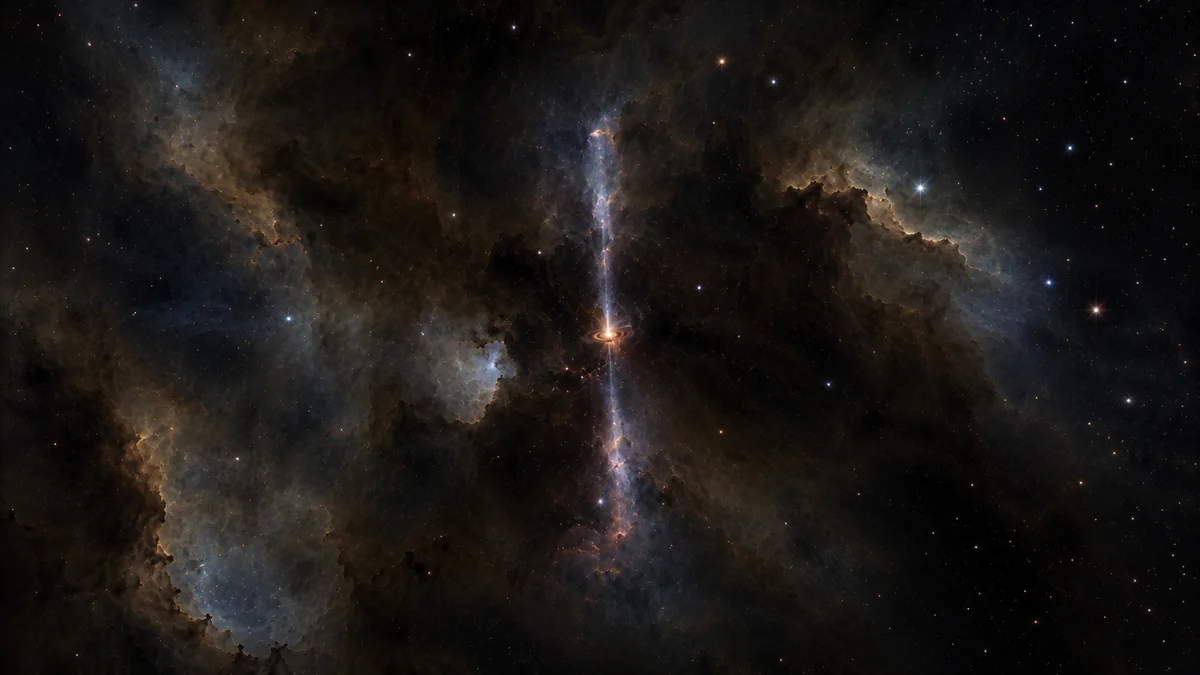
That is the physics behind the hero image for this Transmission: a young object still gathering material while narrow outflows announce its presence into the surrounding cloud.
Which makes:
I was a whisper, I was in tune
Now I am thunder inside the womb
one of those places where the metaphor and astrophysics almost shake hands.
The star isn’t even finished being born.
And it’s already changing everything around it.
Answering the void
Then the bridge ends:
When the void bears its teeth at me
I answer back in gravity
I don’t read that as conquering emptiness.
I read it as refusing to remain dispersed.
Gravity doesn’t defeat the void by filling all of space.
It takes what exists and makes it cohere.
That’s a much more interesting kind of victory.
The first light
The final chorus changes the language.
We aren’t merely burning into being anymore.
Everything falling into the slipstream
We coalesce from the Dust of Dreams
Coalesce is the word the entire song has been reaching toward.
Separate things becoming one thing.
And then the violence finally stops.
The first light opens slowly
Like the first breath after war
All impossible things remember
They were ashes before they soared
There is another beautiful piece of astrophysics hiding underneath that ending.
Star formation isn’t a clean beginning.
The material incorporated into new stars has a history. Earlier generations of stars manufacture heavier elements and return enriched material to interstellar space when they shed their outer layers or die. That material can later become part of new molecular clouds, new stars, new planets—and eventually things capable of wondering where they came from.9
So creation isn’t really the appearance of something from nothing.
It’s transformation.
Old material.
New relationships.
Enough gravity.
Enough pressure.
And eventually, light.
That’s what Dust of Dreams is about for me.
The universe does it with gas and dust.
We do it with fragments of thought.
Everything starts scattered. Creation is what happens when something finally gives the pieces a reason to fall together.
Sources & Further Reading
1. NASA Science — Stars. Overview of stellar formation, including the gravitational collapse of dense regions within molecular clouds. Read at NASA Science ↩
2. NASA Science — Webb’s Star Formation Discoveries. Webb observations of cold molecular clouds and deeply embedded young stellar objects. Read at NASA Science ↩
3. CERN — The graviton and quantum gravity. Background on the hypothetical graviton and the unresolved problem of reconciling gravity with quantum mechanics. Read at CERN ↩
4. NASA Science — Webb’s Star Formation Discoveries. Protostars, disks and the early stages of stellar formation. Read at NASA Science ↩
5. NASA Science — Stars. Protostellar evolution and gravitational contraction before stable hydrogen fusion. Read at NASA Science ↩
6. NASA Science — Types of Stars. Main-sequence stars and the balance between gravity and energy generated by hydrogen fusion. Read at NASA Science ↩
7. NASA Science — How Dense Pillars Form in Molecular Clouds. How radiation and multiwavelength observations reveal and reshape star-forming environments. Read at NASA Science ↩
8. NASA Science — Herbig-Haro 32: Jets of Material Ejected From a Young Star. Young stellar jets and the glowing shock structures created as outflows encounter surrounding material. Read at NASA Science ↩
9. NASA Science — Stars. Stellar nucleosynthesis and the recycling of material from older stars into later generations of stars and planetary systems. Read at NASA Science ↩