TRANSMISSION 26.005
Don’t Make Me Use My Belt: The Most Metal Threat in the Solar System
Inside “Don’t Make Me Use My Belt” by The Gravity Problem: how asteroid dynamics, orbital mechanics and extinction-scale kinetic energy turned an old parental threat into a cosmic metalcore ultimatum.
There may be no sentence in the English language more naturally suited to becoming a metal song than:
Don’t make me use my belt.
It already contains threat, authority, escalation and the absolute certainty that somebody has been warned more than once.
So naturally, The Gravity Problem gave the belt to an unknown cosmic intelligence and made it the asteroid belt.
Humanity has apparently exhausted whatever patience exists above our pay grade.
Who is speaking?
I don’t know.
Maybe an advanced civilization.
Maybe the universe has a maintenance department.
Maybe something god-like has been watching us squander resources, weaponize everything we touch and ignore repeated warnings.
Whoever it is, they’re finished sending messages.
They’re going to throw rocks.
For the last time
The song doesn’t begin like an alien invasion.
There’s no ominous prophecy. No grand declaration of interstellar war. No demand to take us to our leader.
Instead:
For the last time, get your shit together.
We gave you every chance to stop.
Puñeta… un montón de pendejos.
We’ve apparently skipped several stages of first contact.
Whatever is speaking to humanity has been through this before.
Many times.
And now we’ve reached the phase where one language is no longer sufficient to express the disappointment.
Puñeta… un montón de pendejos.
Loosely: Dammit… a whole bunch of idiots.
The universe has apparently seen enough.
Humanity assumes the universe fights like we do
The charges come quickly.
You pushed past the lines we drew in the dust.
You took all our silence as a weakness to trust.
Every transmission met with static and greed.
You drained out the oceans to feed every need.
Whatever humanity was warned about, we didn’t listen.
Worse, we interpreted the absence of immediate consequences as permission.
Then we did what humans are exceptionally good at doing:
we armed ourselves.
You sent up your fighters and locked in your sights.
You think you control how the universe fights.
That’s the setup for the joke.
Humanity assumes that if something powerful ever comes for us, it will fight according to our imagination.
Spacecraft.
Lasers.
Missiles.
Explosions.
Some enormous technological superweapon hanging over Earth.
So when judgment finally arrives:
You brace for the lasers and explosive attacks.
The narrator’s response is essentially:
That’s adorable.
Because why build a death ray when the Solar System has already manufactured the ammunition?
The belt
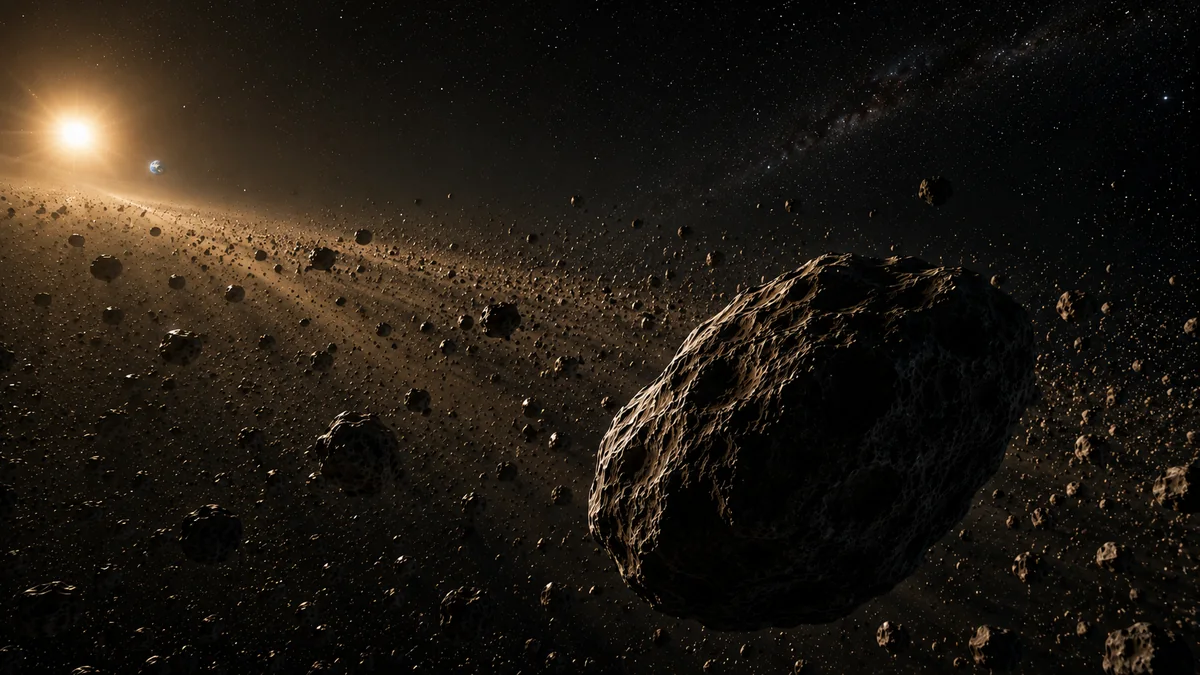
Between the orbits of Mars and Jupiter lies the main asteroid belt: a vast population of rocky and metallic bodies orbiting the Sun. Contrary to the crowded obstacle courses of science fiction, those objects are generally separated by enormous distances and follow their own solar orbits.
The belt contains everything from small fragments to bodies hundreds of kilometers across, including the dwarf planet Ceres.1
Most aren’t wandering chaotically through space waiting to hit Earth.
That’s what makes the threat better.
Out past the orbit of Mars in the black.
I’ll knock those old stones off their track.
The narrator isn’t manufacturing ammunition.
The ammunition has been orbiting the Sun for billions of years.
The threat is simply to change where one of those orbits goes.
The patient weapon
Cold iron and rock ticking off the years.
A million miles of debris confirming your worst fears.
An asteroid doesn’t need to be angry.
It doesn’t even need to be fast by astronomical standards.
It just needs to arrive at the wrong coordinates at the right time.
That’s one of the unsettling things about orbital mechanics: small changes can accumulate into enormous differences in position given enough time.
NASA’s Double Asteroid Redirection Test—DART—demonstrated this principle deliberately in 2022. By impacting Dimorphos, the small moon of asteroid Didymos, DART measurably altered its orbital period. It was humanity’s first full-scale demonstration of asteroid deflection technology.2
The objective was planetary defense.
Our narrator has apparently read the same physics and chosen a different application.
Every orbit waits for one small push.
That’s the scientific heart of the song.
The push doesn’t have to resemble the eventual consequence.
Change velocity.
Change trajectory.
Wait.
The universe is very good at handling the rest.
Gravity finishes what intention’s begun
Every stone remembers where it came from.
I don’t need to drop a bomb.
Gravity finishes what intention’s begun.
That last pair of lines is probably my favorite threat in the song.
The narrator isn’t proposing to continuously propel an asteroid all the way toward Earth.
It only needs to change the conditions.
Once an object has been placed onto the required trajectory, orbital mechanics take over.
Gravity doesn’t know there’s a punishment underway.
The asteroid doesn’t know it’s a weapon.
Physics has no opinion whatsoever about humanity.
Which makes it an excellent accomplice.
The narrator supplies the intention.
Gravity handles delivery.
Rewriting the ephemeris
Then the chorus drops perhaps the nerdiest threat on the album:
Time-out is over, escape is denied.
I’m rewriting the ephemeris, won’t let this slide.
An ephemeris describes the predicted positions and motions of astronomical objects over time. High-precision ephemerides are essential for astronomy, spacecraft navigation and predicting where Solar System bodies will be at particular moments.3
So “rewriting the ephemeris” doesn’t mean our narrator is editing a spreadsheet.
They’re changing the actual trajectory.
The coordinates that once predicted:
the asteroid will be there
now predict:
the asteroid will be here.
And Earth happens to have an appointment at the same time.
That’s an absurdly technical way to threaten someone.
Which is exactly why I love it.
Don’t make me use my belt
After ephemerides, orbital perturbations and extinction trajectories, the song finally lands the joke:
In careless squander long have you dwelt.
Don’t make me use my belt.
Extinction is moving, waiting to be dealt.
Don’t make me use my belt.
Humanity isn’t merely being threatened with an asteroid.
Humanity is being disciplined with the asteroid belt.
It’s an old parental warning inflated to Solar System scale.
The pun is stupid.
The consequence is potentially civilization-ending.
That combination makes it almost unfairly well suited to metalcore.
Altering the periapsis
And then the bridge gets even nerdier.
I’m altering the periapsis just a degree.
Kinetic execution, on its way.
Periapsis is the point along an orbit where an object passes closest to the body it orbits. When specifically orbiting the Sun, that point is called perihelion.4
“Just a degree” isn’t intended as an orbital-engineering prescription.
It’s the language of the threat.
The narrator is emphasizing how something that sounds almost trivial can eventually have a very nontrivial consequence.
This is also where I like the scale of the song.
The punishment isn’t necessarily happening tomorrow.
It could have been initiated years ago.
The rock may already be moving.
Humanity could spend the entire song waiting for a consequence that celestial mechanics has already scheduled.
Kinetic execution
And when the object arrives, it doesn’t need explosives.
Kinetic energy increases with mass—and with the square of velocity.5
That’s the important part.
Double the velocity and you don’t merely double the kinetic energy.
You quadruple it.
A sufficiently massive object traveling at the velocities associated with planetary encounters can carry an extraordinary amount of kinetic energy simply by moving.
Earth’s geological history contains the evidence.
The Chicxulub impactor that struck roughly 66 million years ago is strongly associated with the mass extinction that ended the age of non-avian dinosaurs.6
So:
Kinetic execution, on its way.
isn’t just metal imagery.
The universe doesn’t need to put a warhead on a mountain.
The mountain is enough.
Gravitas, momentum, doomsday
Then we get:
A hard lesson for your pomposity.
Gravitas, momentum, doomsday.
Gravitas is doing some work here.
In ordinary language, it means weight, seriousness or dignity.
But surrounded by periapsis, kinetic energy and momentum, it’s impossible not to hear gravity hiding inside it.
Then comes momentum—the quantity of motion carried by mass.
And finally:
doomsday.
Three words reduce the entire threat to its essentials:
weight → motion → consequence.
That’s basically the song.
Enough with the science. Throw the mountain.
And then the breakdown wisely abandons all sophistication.
No more ephemerides.
No more periapsis.
No more orbital mechanics.
Throwing mountains.
Raining iron.
Falling worlds.
We’ve finished the lecture.
Now throw the mountain.
Then the entire premise collapses into six words:
DON’T.
MAKE.
ME.
USE.
MY.
BELT.
There is something inherently funny about framing an extinction-level impact as discipline.
Not war.
Not vengeance.
A correction.
Humanity is apparently being sent to its room.
Unfortunately, the room may shortly contain an asteroid.
This is for your own good
Then comes the part that makes the whole song worse.
The machinery stops.
The breakdown is over.
And our cosmic disciplinarian calmly explains:
This will hurt me more than it hurts you…
This is for your own good…
I only do this because I love you.
That’s when the satire completes itself.
Our narrator has potentially redirected a mountain toward Earth and is still insisting that we made them do it.
Maybe they’re benevolent.
Maybe they’re monstrous.
Maybe they’re divine.
Maybe they’re an extraterrestrial civilization enforcing some incomprehensible interstellar code.
Maybe the universe really does have a maintenance department.
I don’t want to know.
The ambiguity is better.
All we know is that something has apparently reviewed humanity’s performance, reached the end of its patience and adopted the disciplinary philosophy of an exhausted parent.
Except their belt is located between Mars and Jupiter.
Their warning arrives through orbital mechanics.
And gravity has very strong follow-through.
Don’t make them use it.
Sources & Further Reading
1. NASA Science — Asteroids. Overview of the main asteroid belt, its location between Mars and Jupiter, and the population of rocky bodies orbiting the Sun. Read at NASA Science ↩
2. NASA — Double Asteroid Redirection Test (DART). NASA’s planetary-defense demonstration measurably changed the orbit of Dimorphos through a kinetic impact. Read at NASA ↩
3. NASA/JPL — Horizons System. JPL’s system produces high-precision ephemerides for Solar System bodies and spacecraft. Explore JPL Horizons ↩
4. NASA — Orbital terminology. NASA educational material describes periapsis as the nearest point in an orbit, with perihelion used when the central body is the Sun. Read NASA orbital mechanics material ↩
5. NASA Glenn Research Center — Kinetic Energy. Translational kinetic energy depends on mass and the square of velocity. Read at NASA ↩
6. NASA Science — Chicxulub Crater. Evidence connecting the Chicxulub impact with the mass extinction approximately 66 million years ago. Read at NASA Science ↩